
Humans. We always think something bad is happening somewhere out there, when in truth it is happening right inside our homes.
Representative Jessica Domangue’s article on the Republican Senate primary today is useful because it names something many Republicans would rather pretend is only a problem on the Left. Her argument is worth reading, even if this piece is not meant as a point-by-point endorsement of every conclusion, claim, or implication. My interest here is more in line with the theoretical work we have been doing for a long time now: how the powers that be use pressure, fear, repetition, binary frames, digital mobs, and issue-of-the-day manipulation to shape public behavior while the overwhelming majority of citizens don’t even realize they are being corralled into a cage.
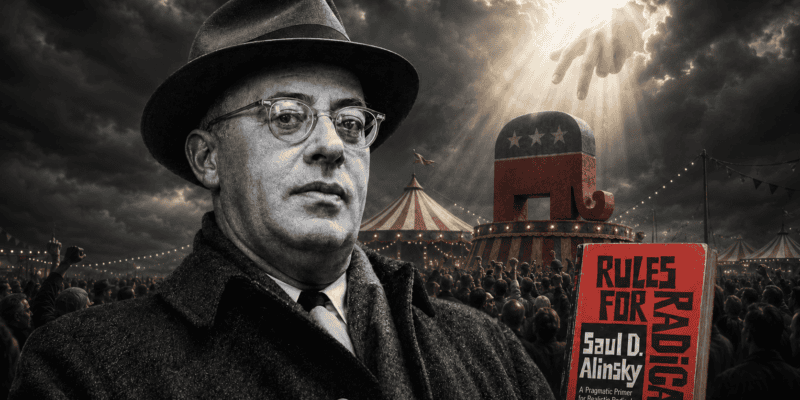
The frame Rep Domangue employs is the Saul Alinskian frame we have used often here.
The Fleming-Letlow race is not merely a Louisiana campaign story. It is another example of how seemingly well-meaning, maybe even grassroots, movements can devolve when truth becomes secondary to politics. Domangue frames the matter through Saul Alinsky’s Rules for Radicals, conceptualizing the important point that such tactics are not restricted to the ideological Left conservatives so vehemently oppose.
Once a political method is detached from moral limits, and that has been the case for decades and decades now, it can be leaked into the mob by anyone, even a Republican who believes himself immune to leftist revolutionary tactics. It can be used by Marxists of all varieties—activists, reformers, influencers, celebrities, populists, conservative gatekeepers, and even people who sincerely believe they are saving their state, but are unwittingly working under Scripture’s operation of error, a warning we have worked through a dozen times over the last several months alone.
Such poison working through even the well-intentioned is what makes politics detached from truth so dangerous, and ultimately, suicidal.
- “Power is not only what you have but what the enemy thinks you have.”
- “Never go outside the experience of your people.”
- “Whenever possible go outside of the experience of the enemy.”
- “Make the enemy live up to its own book of rules.”
- “Ridicule is man’s most potent weapon. There is no defense. It is almost impossible to counterattack ridicule. Also it infuriates the opposition, who then react to your advantage.”
- “A good tactic is one your people enjoy.”
- “A tactic that drags on too long becomes a drag.”
- “Keep the pressure on.”
- “The threat is usually more terrifying than the thing itself.”
- “The major premise for tactics is the development of operations that will maintain a constant pressure upon the opposition.”
- “If you push a negative hard and deep enough it will break through into its counterside; this is based on the principle that every positive has its negative.”
- “The price of a successful attack is a constructive alternative.”
- “Pick the target, freeze it, personalize it, and polarize it.”
When Alinsky wrote about power, ridicule, threats, polarization, and constructive alternatives, he was not merely offering a set of campaign or community tricks. He was describing a psychology of political and societal combat, one that is insidiously slow and methodical. The method works by creating pressure on the target, desensitizing followers to the humanity of their opponents, and producing a mob mentality in which citizens begin to conflate repetition and “mass” of opinion with truth, even when that mass of opinion is woefully uninformed. Whether the rhetoric comes from the Left or the Right, the physics of it remains the same. The public is not reasoned into a position so much as it is cajoled, agitated, flattered, frightened, and trained—all in a series of up and down emotions that has it doing anything to escape the vertigo.
Which includes hunkering down on a side, inside a “tribe,” no matter what that tribe produces in the way of morality. Supporters will Trump-splain and Obama-splain and Pope-splain till they turn blue in the face under a Twitter post, but they’ll never allow into their conscience the notion that, at least in this case, their man could be wrong.
This is an element we call the binary trap we’ve beat the alarum on over the years as well.
Because conservatives spend so much time identifying radical methods on the Left, they can sometimes miss those same methods when they appear inside their own camp. It is one of the most obvious yet oldest errors in politics. We understand blindspots, the wooden beam in the eye as Christ calls it, with automobiles and other groups, but not in our own. A tactic does not become conservative just because a conservative uses it. A manipulation does not become virtuous because it is aimed at someone we already don’t like. If anything, the Right should be more alert to these tactics precisely because conservatives claim to believe in order, prudence, limits, and the moral distinction between an opponent and an enemy.
Although many of Domangue’s examples are specific to the Senate primary, the broader pattern is familiar. A small network of activists or organizations can present itself as the authentic voice of “the people,” especially when social media and its predetermined algorithm allow a select number of voices to appear larger than they really are.
Alinsky’s first rule, that power is not only what one has but what the opponent thinks one has, is almost perfectly suited for the digital age. Because repetition now travels faster than the verification of any given point or story, a claim echoed across several trusted platforms can begin to feel like consensus long before anyone has examined whether it is true.
Domangue is also right to point to Alinsky’s rule that ridicule is one of the most potent weapons anyone of bad will could unleash. Ridicule is effective because it avoids the burden of proof. It celebrates and promotes the logical fallacy. It does not need to answer an argument. It only needs to make the target look ridiculous enough that others become embarrassed to stand near him. When a political culture becomes desensitized to this grave moral degeneracy, it begins to reward the people who are most willing to humiliate others, including spouses, families, or anyone else who can be converted into usable content.
That is not conservatism.
It is equivalent to the worst political activism conservatives have raged against in the dying light.
Advertisement
It is the mob in front of Christ, Barabbas, and Pilate, only in the realm of digitized space. As the character says in the movie Gladiator, “Rome is the mob,” and the mob always wins when truth is detached from the moment. It is what makes the Christian martyrs so great—they were acting in a way identifiably counter to fallen nature.
When this happens, the bystander effect often follows. The Everyman just wanting to live his life and enjoy his family may not agree with the harshest voices, but he stays quiet because he assumes everyone else has already accepted the frame, and worse, that maybe he is the one that is wrong. Legislators may not believe the loudest activists represent the majority, but they hesitate because they do not want to become the next target or lose the next election. Candidates may know an accusation against an opponent is exaggerated, but they calculate that it is easier to bolster the noise than rein it in toward reality, that the mob will listen if they’re bombarded sufficiently with the noise.
Over time, the loudest faction does not need to persuade the public of any truth necessarily. It only needs to turn the volume up and make the prudent and decent people of a community, state, or nation afraid to speak.
I list all three there to emphasize that this type of thing is happening well beyond the four-year presidential cycle. It is not a phenomenon “somewhere out there.” It is happening in your backyard, as Rep Domangue is so admirably attempting to show—regardless of whether you agree with her particular slant on the people and the politics involved.
Those italics are me cautioning the reader against the binary trap as we speak.
This is where our work on the Hegelian Dialectic comes in as well. A first cousin to the Dialectic is the Hobson’s Choice, the illusion of options where no meaningful choice is actually being offered. The public is presented with two bad choices: either submit to something as it is, or join the most aggressive faction against it—all the while some “alternative” option is floated in the ether as the acceptable conspiracy theory, which may be a shadow of Alinsky’s “constructive alternative,” which makes truth-tellers feel daring and rebellious, but ultimately, as wrong as anyone. Having accepted the binary frame, with both sides ridiculing the marginalized conspiracy theorist, citizens then oscillate between fear and anger on Facebook while the deeper question in any given situation remains unanswered. Indeed, it is oftentimes not even asked.
In the Catholic world, we have been applying this principle and human fallenness to the Leo-Hildebrand question.
It is the same psychological principle at work in the Revelation of the Method. Once people have been conditioned long enough, later disclosures do not necessarily produce the desired and expected reform. Sometimes they only produce quiet, effeminate resignation—which falls right into the enemy’s hands. The public learns that it was manipulated all along, sure, that narratives were managed, sure, that special interests were hidden, sure, and that facts were obscured, sure. But since nothing ever changes because the spectacle has already done its work on the mob and on well-meaning minds, citizens become desensitized, concluding that everything is corrupt, everyone is lying, and no constructive alternative is possible.
The fighters stop fighting and the guardians stop guarding.
God makes the enemy hide in plain sight. They reveal their method. But in our obstinancy with the bread and circuses, and our absolute refusal to run our souls and our homes His way, we continue to be able to do nothing about it.
Although Representative Domangue’s piece is aimed at a particular faction inside the recent Republican election, the warning can be viewed as much broader, much more universal, much more cosmic. Louisiana conservatives must not let their justified distrust of the establishment cajole them into accepting leftist revolutionary methods simply because those methods are now being used by people who speak conservative language or wear red ties. Once such an insidious Alinskian method forms the soul, the color of choice matters less than we think. A Republican who uses Alinsky to destroy trust, dehumanize opponents, and avoid constructive responsibility has not defeated the Left. He has unleashed its methods on an unwary populace, and quenched the insatiable bloodlust of the mob.
Advertisement
Advertisement
