
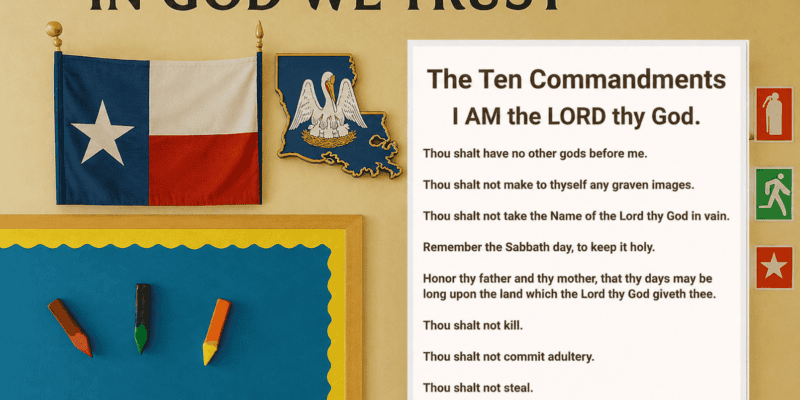
Last week, we committed to crawling into the past a bit through the ancient and competing Jewish and Christian listings of the Ten Commandments. Today we give our best effort to show just how far the incongruence discussed in the first article of this series goes.
Keep in mind that this isn’t an exhaustive analysis of old texts by any stretch, just a touch to make our point about the listing on the Commandments poster in public school classrooms.
In the first article, we established that Scripture gives us the “ten words” without placing an inspired numeral beside each one, hence the TEN AND OH series title. We also presented the two places where the Catholic listing divides the text differently from the text being posted in public school classrooms, involving the prohibition against graven images—which Catholic tradition includes within the First Commandment against idolatry—and the final prohibitions against coveting, which it divides into the Ninth and Tenth Commandments.
Because the biblical text itself contains more than ten imperative statements—which might seem to indicate more than Ten Commandments, an idea every Christian out there would scoff at—some of those statements have to be grouped if the total is to remain ten.
And disagreements with that arrangement go way back.
The history begins long before the Christian vs woke squabbles of the 21st century, long before the Protestant Revolution, even long before Saint Augustine, all of which makes any simple Catholic-vs-Protestant debate fundamentally inadequate.
After reading this for the first time, one might come to believe that the woke vs conservative Christian paradigm is inadequate as well.
The listing familiar to many Protestants and Eastern Christians also has ancient roots, and keep in mind this is a Catholic writer presenting this to you today. There is indeed precedent for the prohibition against other gods to be identified as the First Commandment, the prohibition against graven images as the Second, and the forms of coveting coupled together as the Tenth.
Philo Judaeus, who was a leading first-century writer of the Hellenistic Jewish community in Alexandria, Egypt, followed that enumeration. He distinguished worship of the one God from the making of images, kept all covetousness under the Tenth Commandment, and placed five commandments on each tablet, counting the command to honor one’s parents as the fifth and final commandment of the first tablet.
Here is his arrangement. It’s tough reading, but I present one of his tablets here to help make the point.
Now God divided them, being ten, as they are, into two tables of five each, which he engraved on two pillars. And the first five have the precedence and pre-eminence in honour; but the second five have an inferior place assigned to them. But both the tables are beautiful and advantageous to life, opening to men wrought and level roads kept within limits by one end, so as to secure the unwavering and secure progress of that soul which is continually desiring what is most excellent. (51) Now the most excellent five were of this character, they related to the monarchial principle on which the world is governed; to images and statues, and in short to all erections of any kind made by hand; to the duty of not taking the name of God in vain; to that of keeping the holy seventh day in a manner worthy of its holiness; to paying honour to parents both separately to each, and commonly to both. So that of the one table the beginning is the God and Father and Creator of the universe; and the end are one’s parents, who imitate his nature, and so generate the particular individuals.
Philo’s numbering at the two disputed points from article one prefigures the list later adopted by Reformed Christianity, but his division of the tablets was five-and-five rather than four commandments concerning God and six concerning our neighbor.
Josephus, writing at the end of the first century, gave essentially the same list:
915. The first commandment teaches us that there is but one God, and that we ought to worship him only. The second commands us not to make the image of any living creature to worship it. The third, that we must not swear by God in a false matter. The fourth, that we must keep the seventh day, by resting from all sorts of work. 92 The fifth, that we must honor our parents. The sixth that we must abstain from murder. The seventh that we must not commit adultery. The eighth, that we must not be guilty of theft. The ninth, that we must not bear false witness. The tenth, that we must not admit of the desire of any thing that is another’s.
By the third century, Origen was using the same First-Second-Tenth numbering. He arranged the tablets according to the four-and-six division, if my reading is correct.
Advertisement
More importantly for our purpose of illustrating the incongruence—not deciding who was right—Origen openly acknowledged that another Christian grouping already existed. In Homily VIII on Exodus, he explained:

Origen thus rejected the competing division, but he knew it existed—which points to the incongruity we aim to illustrate. Although he preferred to separate other gods from images, some Christians in the third century were already treating the entire passage as one commandment, which means the grouping later associated with Catholicism didn’t suddenly appear as the papists’ attempt to hide the biblical prohibition against graven images.
The rabbinic Jewish arrangement complicates matters even more. It begins the list one line earlier than either of the aforementioned Christian arrangements. It identifies God’s declaration, “I am the Lord thy God, who brought thee out of the land of Egypt,” as an entirely separate statement, the first of the Aseret HaDibrot—literally, the “Ten Statements” or “Ten Words.” Consistent with that reading is the Babylonian Talmud, Makkot 24a, which identifies “I am the Lord your God” and “You shall have no other gods” as the first two commandments.

Under this Jewish numbering, the second word or commandment begins with the prohibition against other gods and continues through the prohibitions against worshipping graven images. All forms of coveting remain together under the Tenth. This complete English presentation of the traditional Jewish numbering clearly displays that arrangement:

By counting God’s opening declaration as the first word, the Jewish listing treats His identity and His deliverance of Israel from Egypt as part of the Ten in its own right, not as a preface placed before the numbered commands. It therefore differs from both the numbering familiar to most Christian groups we have represented today and the Catholic listing, which we have, of course, yet to cover beyond the introduction of article one.
All of this should also clarify why ancient thinkers didn’t just list the 14 Commandments or the 12 or 13. The scriptural expression “ten words,” which to my knowledge is accepted by all the groups discussed here, fixed the total at ten, indicating the number of commands. Exodus and Deuteronomy indeed identify the total as ten, but neither places inspired numerals beside the individual statements. Thus different Jewish and Christian traditions agree upon the biblical text while drawing some of the boundaries between its ten parts differently.
We come now to the specifically Catholic listing we have deliberately postponed until the third and (possibly) final installment, where it can receive more than a hurried paragraph at the end of an already history-heavy lesson. The content of this series is growing perhaps without my conscious consent, and so we thank you for your patience while we walk slowly through it together.
Thank you for reading The Hayride!
Advertisement
Advertisement
