
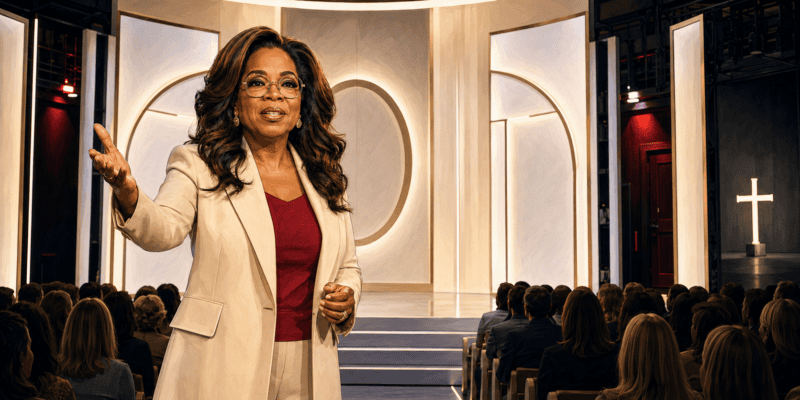
To write on politics is one thing, one level of the beast. To bring in religion and the spiritual world takes it closer to the level it is.
And whether Scott McKay was intending that or not in his most recent American Spectator piece, we applaud him for this most important article, while also admitting that what we add here is not necessarily his point of view. I want to be fair in that regard to the autonomy of his piece—something I as a writer need to remember to say when I piggy-back off of fellow writers’ work.
It’s Religion
Scott’s indictment of Oprah Winfrey begins with therapeutic socialism, but one of the most consequential lines in his article appears before he even begins telling her story:
“It isn’t even politics; it’s religion.”
That is more than a clever play on words. Scott is arguing that therapeutic culture has developed its own catechism, moral universe, definitions of innocence and guilt, and even rituals of public confession and promises of salvation. Oprah didn’t merely popularize the incredibly destructive self-absorbed psychology damning Americans today. She helped train two generations to believe that suffering should by definition create authority, that feelings reveal truth (we’ve explored this with Modernism and the Catholic Church), and that healing requires never-ending, narcissistic processing rather than repentance, discipline, and a sincere change of life.
If I can provide my own admittedly narcissistic testimony, I can say this is most assuredly what I fell into when my personal life hit rock bottom many years ago.
Once all of Oprah’s version of the “American dream” was absorbed by the political Left, that faith supplied the spiritual foundation for therapeutic government, the abominable Nanny State, which promises soothing attention to every wound—whilst progressively collecting the power to dictate who is wounded and who is responsible.
What progress.
Of course, although the contemporary Left represents the most advanced political expression of this false religion, conservatives should not assume they are immune to the underlying temptation.
When a political leader is treated like a savior, when loyalty to a party starts to feel like proof of moral standing, or when every setback has to be explained away as part of some hidden master plan, politics has already slipped into a religious role. We don’t intend, of course, to suggest that the Republican and Democrat parties are morally identical, and it doesn’t stop Christians from evaluating policies or supporting what is right. It simply means that these two parties have given more than enough evidence to support the notion that they branch from the same wicked vine. On the surface, sure, there is a difference, and that can be a good start, but no politician and no movement is fit to carry the kind of trust that belongs to God and His Kingdom alone.
Many Americans will attribute nearly every evil committed in God’s name to “man-made religion.” There is truth inside the warning, because men can absolutely corrupt religious authority. That much is obvious. But Jesus Christ was also “a man,” and he commissioned “men” to spread his Gospel to all the ends of the Earth. Scripture does not present man as a naturally secular creature who becomes religious only when a shadowy institution gets hold of him. From Cain and Abel bringing their offerings, to Israel fashioning the golden calf, to Saint Paul warning that men who reject God will worship the creature rather than the Creator, Scripture presents man as a religious creature. He will worship something.
“And worship happens here….”
When man rejects the true God, therefore, he does not then become neutral. As Saint Paul writes, he “worshipped and served the creature rather than the Creator” (Romans 1:25). Removing true religion merely creates a void into which another religion moves, carrying its own authorities, sins, rituals, judgments, and promises of salvation. This is precisely what Oprah’s false gospel supplied. She did not teach an irreligious America to stop believing. In Freud-like fashion, she gave an increasingly post-Christian America something else to believe in—the therapeutic self— with Oprah and her circle interpreting its wounds, identifying its sinners, and offering the path toward independence and self-freedom for the wronged.
Thus, because man will worship no matter the god, traditional Christianity had warned against such confusion for centuries. For the Old Church, which insisted on strictness for the very reasons so many conservatives bemoan the culture today, the state possesses legitimate but limited authority, while culture can preserve and transmit truth—but cannot create it. “Speaking Your Own Truth” is a lie. Once either sphere begins demanding the submission owed to God, the power inevitably created becomes the object of worship, even when it continues calling itself seemingly innocuous names like politics, progress, tolerance, or patriotism.
This is a struggle through which even the Church, in her human administration, has had to navigate. Whenever clergymen have become dependent upon state protection, worldly acceptance, or institutional promotion, the Church’s supernatural mission has been obscured—which is where the attack on “man-made religion” stems. At this point in history, we can see much of the infiltration Scott describes moving through her walls as well—right here and right now in the Vatican, in the USCCB, and across the world—with language of therapy and synodality displacing the Old Church’s insistence on penance, the protection of souls, and the building of Christendom. It is one reason so many have left that Church, because frankly, even I as a Catholic admit, it doesn’t even resemble the old one.
Again, these are all topics this space has explored in depth. See the archives for more.
Power Protects Its Own
Traditional Christianity does not treat suffering as something to be merely processed or dissolved, and especially not broadcast for all to see on a 1980s talk show or Facebook today. It is something to be united to Christ’s own Passion—where wounds are taken up, not erased artificially, and offered to Heaven for our own repentance, our own sanctification, and the conversion of others.
Thus, the greatest danger of Oprah’s gospel is not simply that it devolves this salutary suffering into psychological victimhood. It replaces the older Christian instinct to bring one’s wounds to the Cross with a false framework that treats pain primarily as something to be managed, validated, and ultimately centered on the self.
Advertisement
Moreover, it can actually perform two insidious operations at once, making trauma fashionable and nearly universal, yes, while also training the public to overlook the organized evil that creates real victims. Everyone learns the language of healing and empowerment, but fewer people ask who abused the children, who trafficked them, who protected the perpetrators, who buried the evidence, and who will suffer eternal hellfire unless they sincerely repent of their most chilling crimes.
Actually, somewhat counter to our thesis today, I remember Oprah airing one story that related to exactly this. It was stunning then, and it is still stunning now, when I see the clip floating about online. You may remember the one, and I apologize for not having it on hand today.
Such meaningful revelations, of course, were hardly the norm. Scott’s section on John of God deserves particular attention. Oprah presented the supposed Brazilian healer to vulnerable women as “a source of miracles”:
In 2010, Oprah devoted a full episode of her show to the man, titled “Do You Believe in Miracles?” She followed it with a glowing O Magazine profile. Then, in 2013, she flew down to Brazil with a camera crew for Oprah’s Next Chapter. She watched him perform “surgeries” — cutting into women’s bodies without anesthesia, jamming forceps up noses, the whole carnival act. Instead of reacting with horror, she called the experience “inspiring.” This was a guy who claimed to channel dead doctors for miracle cures, and she was touting him in front of the world, with real — and ugly — consequences.
By December 2018, hundreds of women — eventually numbering more than 600 — accused John of God of sexual abuse, molestation, and outright rape during those “healing” sessions. Some were as young as nine. There were even whispers of a “baby farm” operation whereby Faria was allegedly harvesting children of his victims for sale on the black market. He surrendered to police, denied everything at first, and then racked up convictions totaling 489 years in prison. One of Oprah’s own 2010 guests, a Harvard psychiatrist named Dr. Jeffrey Rediger, later revealed he had warned her producers about existing rumors of sexual misconduct.
They ignored him. Ratings week trumped caution, and New Age “wonders” trumped objective reality.
Earlier, Scott had provided the result of this abject atrocity in four words: “Power protects its own.” Such dynamics of institutional self-protection often determine what is acknowledged and what is dismissed.
This pattern becomes especially clear when contrasted with traditional Christianity, which would, if only summoned in earnest, supply the categories that have been lost. It can acknowledge that suffering is real without transforming suffering into an identity. It neither blames an abused child for failing to demonstrate sufficient grit nor surrenders that child to a therapeutic system that converts pain into permanent dependency. True Christianity calls the sinner to repentance, the magistrate to justice, the victim toward restoration, and the faithful toward prayer, penance, and reparation.
It is why politics alone will never solve the ongoing and myriad issues plaguing us today.
Final Words
Celebrity evangelists don’t need to understand fully what they are promoting—or whom it ultimately serves–for the spiritual effects on God’s children to be real. Scott’s identification of such a warped system as a religion thus opens an unavoidable spiritual challenge. When a cultural high priestess spends decades directing millions of even well-meaning souls away from sin, judgment, and the true Christ, while promoting spirit-channelers, counterfeit miracles, and a man claiming to communicate with the dead, Christians are permitted to ask what spiritual power such a religion ultimately serves. A false religion does not become spiritually neutral simply because it presents itself as kind, comforting, and far removed from the murders, ritual abuse, and other spectacular evils people more readily recognize as demonic.
Evil does not always have to look monstrous to lead souls away from Christ. Sometimes it only has to look nice.
Scott is right that America cannot be saved by therapeutic socialism. Neither will it be saved by replacing the religion of the political Left with another political religion on the Right, or by converting grave evil into one more spectacle through which a party, personality, or institution acquires power. Before protecting the brand, movement, celebrity, or leader, we must protect the children, protect our souls, and put the eternal salvation of ourselves and others first.
That is not therapy. It is the beginning of God’s good justice—and, for a Christian people, perhaps the beginning of repentance.
Thank you for reading The Hayride!
Advertisement
Advertisement
