
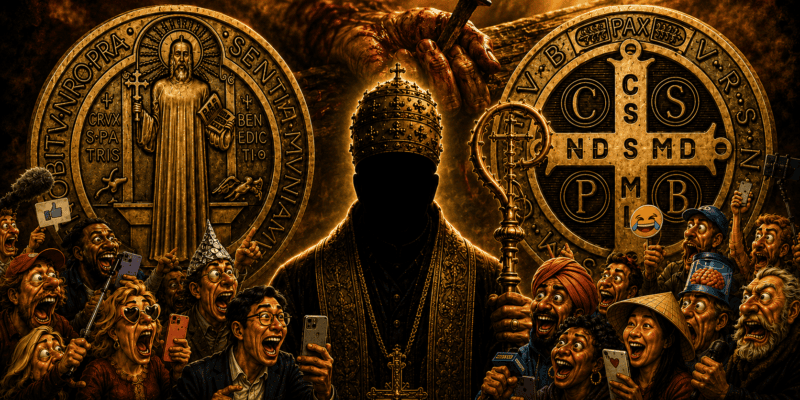
If the screen has trained Catholics to confuse visibility with truth, Matins for the Feast of the Most Precious Blood shows how the Church forms the mind through law, psalm, sacrifice, and judgment.
In the first part of this piece, Saint Benedict gave us the larger pattern: when the old order no longer deserves confidence, the Catholic answer is not panic, nostalgia, or endless commentary on the ruins. It is order.
If Catholics are going to see through the screen and the spectacle, they must return not only to Catholic law and Catholic memory, but to Catholic time – to the liturgical life that forms the mind according to God rather than according to the hour’s noise. That is where the Divine Office has helped bring a spine to my own daily life in addition to the Rosary, and why I keep returning to it in these pages.
That brings us back to the Feast of the Most Precious Blood, and specifically to Matins.
Matins Continued: The Blood Forms the Mind
We have already spent time with the Divine Office through the Hymn of Matins for the Feast of the Most Precious Blood, and we have already touched, however briefly, on the Circumcision.
But the Divine Office for July 1, the pillar of the rest of the month, does not leave us floating inside a generic devotion we take for granted. After the Hymn, Matins moves into Nocturn I, and the Church immediately places the Blood of Christ inside tangible things, like law, name, kingship, agony, betrayal, priesthood, and judgment.
We probably attach a few of these to the Blood, of course, but do we not miss some? Each one is specific, and taking our time with each—each pregnant term—will help us understand what it truly means to be Catholic, and not some cheap imposter.
The first antiphon of Nocturn I is taken from the Circumcision:
“And when eight days were accomplished for the circumcising of the child, His Name was called Jesus.”
The Church begins humbly, with the Child submitting to the Law, receiving the Name appointed by Heaven, and shedding the first drops of the Blood by which the world would be redeemed. The Blood, in other words, appears first under obedience and attached to the only name that saves. The Redeemer is named according to divine command and enters history through the humility of lawful submission, not through a kingly spectacle, a popularity contest, or the approval of the crowd.
Remember, as always, the crowd chose Barabbas.
In a strange time where men relish what the screen glorifies for them, worship athletes as “queens” (but don’t you dare call Mary that!), call an NBA basketball star “King,” and allow the entertainment world to determine reality for them, the Office here continues simply with the bleeding Savior God sends as a mere baby and gives a name.
Before we ever reach the later controversies that consume us, Matins has already taught the first principle: The truth of anything does not come from its reception by the world or something along the lines of “universal acceptance.” It comes from God, it is often hidden, and it must be received according to the order He has given.
This hiddenness should provide skeptics reason to open their minds to Hildebrand—so much of what God does in the spirit of Romans VIII.28 is veiled, and waiting.
Then comes Psalm 2:
“Why have the Gentiles raged, and the people devised vain things?”
The kings of the Earth and the princes gather together against the Lord and against His Christ. It is the ongoing and permanent reality of rebellion. Peoples grow civilized, grow arrogant, and then rage against Him who once saved them. Public life becomes a theater. The powerful claim the right to rebel against His divine rule.
And yet notice the Psalm doesn’t say the faithful must panic over the noise. It places the noise in God’s hands: “He that dwelleth in heaven shall laugh at them.”
It is yet another place in Scripture that points to one simple fact every well-meaning Catholic can take heart in: God shall not be mocked.
The day of truth—of visible truth—is coming.
Saint Benedict helps us understand the psalm as well. Benedict didn’t answer the collapse of Rome by looking back or a never-ending diagnosis of the problem, as we sadly see on YouTube today. He answered it with both eyes toward the Kingdom of Heaven.
That is what I work tirelessly to remember while I wait for God’s definitive word concerning the pope. He is waiting for a reason, and I must wait with Him.
Psalm 2 does the same. After showing the rage of nations and the conspiracy of rulers, it commands understanding, fear of the Lord, service, and discipline:
“And now, O ye kings, understand,” and later, “Embrace discipline.” That is Benedictine in spirit before we ever speak of the Rule. The Catholic answer to the madness of the age is not to become mad in the opposite direction. It is to receive sound instruction, embrace discipline, and serve the Lord with fear and trembling, as both Saint Paul and Saint Peter write.
If the screen has trained Catholics to accept online posts and their reactions as truth, then Psalm 2 retrains the mind to see that metaphorical crowd and its ruler under God’s judgment. The mob of Twitter is not the measure. The ruler inside the algorithm is not the measure. The spectacle in a YouTube comment section is not the measure. Christ is King, and every other king, prince, institution, priest, bishop, journalist, content creator, and layman must bow beneath Him. He is the measure.
That is the public lesson of Psalm 2: raging nations, conspiring rulers, vain speech, false measures, and the triumph of Christ the King over all of it. Psalm 3 then brings the same war inward, into the soul that feels surrounded.
The second antiphon places us in the Agony in the Garden:
“And being in an agony He prayed more earnestly, and His Sweat was as it were great drops of Blood falling down to the ground.” Then the Church gives us Psalm 3: “Why, O Lord, are they multiplied that afflict me? many are they who rise up against me.” This is not detached theology. This is the prayer of the faithful soul surrounded, mocked, pressured, and tempted to believe that the numbers are proof. It is the spoken and unspoken pressures that make a man doubt what he is seeing, and thus the doubt makes him seem dubious: “Many say to my soul: There is no salvation for him in his God.”
It is one of the oldest weapons used against the soul: isolation made to feel like abandonment. You are alone or among the few, and so you must be wrong. You are mocked, and so you must be unsafe to stand near. You hesitate, and so the question itself must not be of God.
Advertisement
The Office answers that temptation with holy, humble confidence:
“But thou, O Lord art my protector, my glory, and the lifter up of my head.” A Catholic mind formed by Matins learns to distinguish between social pressure and divine judgment. They are not the same thing.
It is important to remember this in our prayer lives, because many Catholics are not only confused. They are afraid of being seen as confused. They are afraid of appearing extreme, unstable, disloyal, or ridiculous. So they wait for the approved voices to give permission. They wait for someone with an audience to tell them the question is safe. But Psalm 3 does not teach that. It teaches the soul to stand before God while many rise up against it. It teaches that the surrounded soul may still be protected by the Lord.
And so, where Psalm 2 teaches Catholics not to be impressed by the rage of rulers and nations, Psalm 3 teaches us not to collapse when that same pressure becomes personal. Together, they form a Catholic mind capable of asking unpopular questions without confusing unpopularity with error.
This is paramount in understanding Hildebrand, and perhaps why I am writing this as a reminder for myself as well today. The question must consistently be brought back to God, to law, to order, to prayer, and to the courage to let the truth become visible in God’s time.
Final Thoughts
The Catholic problem in our time is not only that the world lies. It is that Catholics have been trained to receive lies through respectable channels and then mistake the delivery system for reality. All of it is the prince of this world—and he is cunning.
Saint Benedict teaches how to escape him, and so does Matins. The Office denounces the spectacle and forms the soul by psalm, antiphon, feast, liturgical season, tradition, and repetition—and repetition.
It is difficult, manly training.
The regimen is necessary, because the Hildebrand question, whatever its final answer, has exposed a weakness in many of us. Many Catholics do not know how to judge apart from the crowd. Indeed, the vast majority don’t even know the possibility that a pope might be an antipope exists.
I include myself in that weakness, perhaps not as much with the documents against Leo as with the blessing of Hildebrand.
And as I write that, maybe I realize one telling thing about myself that might explain to some dear readers why I am having difficulty: I have always struggled with the notion of God being a loving Father, and that stems from my relationship with my earthly one. And so in writing just this article alone, perhaps even that one paragraph prior to this one, I have come to the conclusion that maybe some of you share: This is less a Hildebrand hesitation for me as much as it is a God the Father hesitation.
Hm.
There is work to do, in spite of whatever hesitancies we all hold. No matter what, we must rebuild the Catholic mind so that it can judge Catholic questions with prayer, fasting, law, liturgical time, discipline, and courage.
And in my case, so that it can trust in full that God the Father wills the good for those who love Him.
Saint Benedict, pray for us.
Most Precious Blood of Jesus Christ, salva nos.
Advertisement
Advertisement
