
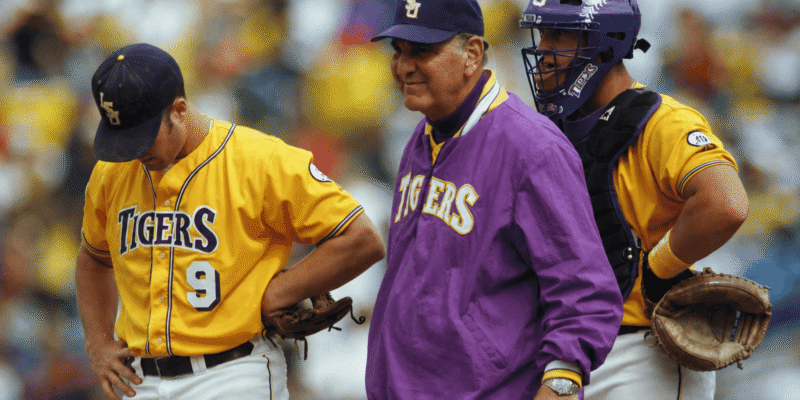
Skip Bertman, the five-time national champion and so much more, died early this morning at 88, leaving behind more than baseballs on a billboard.
And it is one of those moments where death makes you maybe a little too sentimental, but sincere and thankful nonetheless.
It reportedly happened at 1:12 Friday morning at Baton Rouge General Hospital, surrounded by his daughters. He was 88 and had been briefly hospitalized with heart-related issues. His wife of 63 years, Sandy, died in March 2025, and their daughter, Dr Lisa Jo Bertman Pate, died in 2012. He is survived by daughters Jan, Jodi, and Lori, and his grandchildren.
People will rightly say that Bertman built a dynasty in Baton Rouge, and really for all of college sports. For those of us who grew up with it, however, his accolades felt even bigger.
The Transfiguration celebrated on August 6 is not a sports metaphor, and we purposely left it out of the August 6 article special to Bertman. On Mount Tabor, as related in Scripture, Christ doesn’t become divine; He permits Peter, James, and John a glimpse of the glory that is already inherent to Him.
Keeping that distinction unmistakable, the lower, human word “transfigure” can apply, and we will indeed use the word today: Skip Bertman transfigured LSU baseball. He changed what it was, what it expected, and what Louisiana children believed they might see on that television screen or through the voice of radio great Jim Hawthorne.
It is a theme I explore in my 51/Play on Andre series on Substack. My education on the impossible began before the national titles, which provided the contrast needed to make the first one so remarkable. There was the 1987 College World Series loss, when Stanford’s freshman Paul Carey hit a two-out grand slam off freshman star Ben McDonald in the bottom of the tenth inning. The Cardinal would eventually win that CWS championship.
But there was also May 28, 1989, when LSU swept a doubleheader from 58-5, top-ranked Texas A&M in College Station to reach Omaha.
Skip and LSU baseball helped show me that sports could send you to the dumps one day, then lift you to the impossible the next.
And more, that I had to learn from it.
In 1991, I sat alone on the floor in front of our family’s big-box television and watched LSU win its first national championship. I couldn’t believe I was witnessing something I had assumed happened only to other teams somewhere “out there.” I probably watched every pitch, almost afraid that looking away might make it prove unreal.
There was no way they could beat Wichita State, right? Not the Shockers. They were like Stanford, invincible, at least when it came to the team I pulled for.
Advertisement
I admit that my mind goes to what may seem like strange places sometimes, particularly those of Scripture, but there is something faintly recognizable there in Saint Peter’s desire to build tabernacles and remain on the mountain. My boyhood moment was infinitely smaller and certainly not at all sacred, but the instinct was similar:
LSU won. This is good. I want it to stay.
The later championships in the ‘90s and 2000 went differently. In 1993, I alternated between painting my room and watching Brett Laxton coast through a 16-strikeout shutout. In 1996, allergies had me so sick that I abandoned the game after a few innings and awoke to discover I had missed Warren Morris’ version of the impossible. In 1997, work cost me LSU’s six-run first inning against Alabama, although I saw the remainder of a championship game that never seemed in doubt, and have etched in my memory Doug Thompson’s singular celebration that ended up on the front page of The Advocate. In 2000, I spent the day serving as best man for a childhood friend in Buffalo, trying to keep up somehow through phone calls back home whenever I could and without disrespecting my best friend’s day.
And so 1991 was the only championship game I watched in full, refusing to peel my eyes from the screen. Yet that is part of what Skip Bertman gave us, in a way. I couldn’t remain on the mountain as a young fan, and eventually I didn’t have to. The titles became markers inside ordinary life—a bedroom painted, sickness slept through, a Saturday shift satisfied, a friend married—while Jim Hawthorne’s radio voice carried countless rallies through the years between them.
Bertman won five national championships, seven SEC titles, and 870 games in 18 seasons, then served as LSU’s athletic director from 2001 through 2008. Sure, those numbers explain his greatness in athletics and as a business man. But what they don’t do is entirely illustrate the gift given to a young man who needed sports sometimes to believe in greater things. For both better and worse, that has helped shape who I am and what I inject into my characters today.
And if there’s one more thing I could ask, it’s that Jay Johnson bring back the purple-colored TIGERS on the gold jerseys. Keep the white numbers, but the uniform needs the anchoring of the purple. That’s how Skip first designed them.
Skip Bertman made the impossible visible in 1991, perhaps even before then in 1989. then made it familiar without ever making it ordinary, somehow. He didn’t give my generation of baseball players just one afternoon on which to stay. He helped shape what and how we believe.
Again, that shouldn’t be the job of a baseball coach, but I learned over the years to unite it with my Catholic faith. And sometimes, that has made all the difference, as sentimental as that can be.
Thank you for reading The Hayride!
Advertisement
Advertisement
