
Let’s not bring back the magic this time. That didn’t last.
Let’s bring the darkness instead, even in the wide open spaces of daylight.
Sometimes in life, something goes wrong for so long that we begin expecting the pattern to continue without end. We prepare ourselves for the disappointment, recognize in every little detail another indication that it is coming again.
Older LSU fans know something about this pattern, and when it is combined with a blind enthusiasm and insistence that young football players do what it takes on the field to determine the fans’ moods for the rest of the weekend, it can make for a most volatile emotional life during the fall.
In other words, we don’t like the pattern, so in our minds we win the games and championships to break the pattern, even though we will have no direct impact on the actual field of play.
Think about that.
The pattern has been entrenched for a long time. There was the dread of a morning or afternoon kickoff, particularly those ones on JP Sports. Who could forget the Ole Miss loss in ‘97 just one week after toppling No. 1 Florida at night, or the inexplicable 2:30 beatdown at the hands of Notre Dame the same season LSU mauled them later in the Independence Bowl at night?
There has been letdown after letdown after big victories, perhaps something the younger generation cannot understand, but one aspect of it has been circulating lately, both through Coach Kiffin and the Nick Saban TV series, called Relief Syndrome. For the older among us, there have always been a few games every year that could change the direction of a season, perhaps even the entire program, and there is still that uneasy feeling that LSU will find a way to lose—especially if the sun is still beautiful and bright out.
The problem was largely corrected by Saban and remained relatively non-descript under Coach Miles. After some early success under Coach Orgeron and a national title in 2019, it seems that the program is once again mired in this most debilitating place of recognizing the pattern, expecting the pattern to continue, but relying on young players outside the fans’ control to make sure the pattern is interrupted—and permanently.
Coach Kiffin must now establish the kind of steadiness Saban and Miles cultivated. There will be losses, of course, but they shouldn’t keep happening through the same familiar failures. Rightly or wrongly, plenty of Tiger fans believe the years since 2019 have brought back too much of what they remember from the 1980s and 1990s. If you’ve followed this space, you know we’ve been exploring this phenomenon quite a bit.
And when it comes to Alabama visiting Tiger Stadium, the pattern goes back even further.
Since beating the Tide at home in 1969, LSU has gone 5-22-1 against them in Baton Rouge. Five victories: 2000, 2004, 2006, 2010, and 2022 (Saban 2, Miles 2, Kelly 1). That last one is LSU’s only home victory in the past seven meetings there.
That shouldn’t be the norm for a program like LSU. It really shouldn’t be the norm even for teams of less championship prestige than the Tigers.
Of course we’re not claiming that the Tigers should win every meeting as the Tide program has claimed supposed national championships throughout history. But 2022 shouldn’t feel like the anomaly, and the program shouldn’t have to wonder if it’ll ever experience such victory over Bama like that again.
Whether we remember the electric second half and late lead blown in 2012, when TJ Yeldon scored on that screen pass with 51 seconds remaining, or the opportunity blown in 2014, when LSU recovered a fumble at Alabama’s six with 1:13 left, only to settle for a field goal after a bone-headed, stupid personal foul penalty (yes, the refs could have swallowed that whistle, I agree) and lose in overtime, it isn’t hard to recognize that these weren’t all games the Tigers were incapable of winning, such as the one in 2002, that 31-0 drubbing just one week after the Bluegrass Miracle.
2012 was especially frustrating for fans, as finishing the job would have changed the championship picture: With the remaining regular-season results unchanged, LSU would have won the West at 11-1 and gone on to the SEC Championship against Georgia again, and that, just one year after arguably being robbed of a third national title in nine years when it was Bama and not Oklahoma State playing in the Superdome in January.
Alabama drubbed Notre Dame in the 2012 BCS Championship Game to repeat as national champions.
Oh what could have been, if you think about it. And I’m sure you have.
So Coach Kiffin and Coach Baker, can we please not play prevent defense tomorrow, like… at any point in the game?
The Standard Can’t Depend on Sunset
“… will find its home in the western sky, and it will be Saturday night in Death Valley…”
Cue the loudest roar of the crowd.
Eh, let’s fix that, even though yes, it is a cool moment cascading down from the press box and little tradition now.
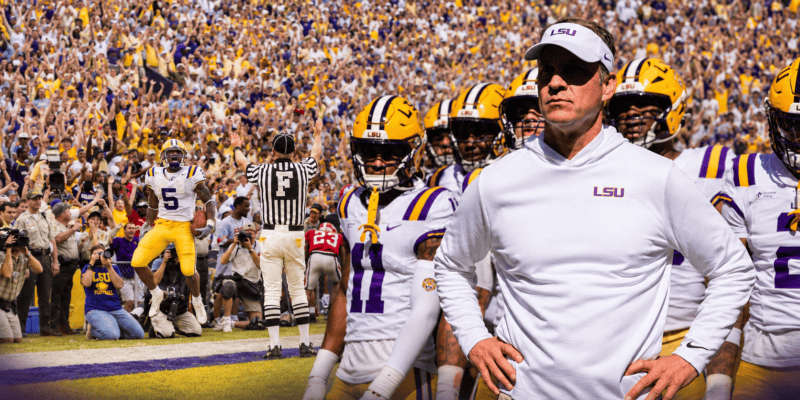
This week, Kiffin challenged Tiger fans to adjust their routines for Saturday’s 2:30 kickoff.
“If you’re used to 6:30, start your day earlier. Have breakfast earlier. Start drinking earlier. Whatever your routine is, move it up.”
Beyond the drinking joke, it is a reasonable expectation, and I love it when coaches reach out to fans like this instead of the normal coach-speak: Bring the energy when the game is scheduled. But more than that—and I’m not sure many people talk about this—sure, the electricity can be something else at night in that stadium, but we’ve also been witness to an early hangover when LSU comes out of the gates slowly. We’ve seen stands clear to beat the traffic.
So we’ve been here before, and like Saban once said, if you’re going to be a national title contender every year, you’re going to be scheduled to play under the sun quite a bit by the networks. Maybe not as much now with the switch from CBS to ESPN for SEC coverage, but the idea still holds.
Before hosting Alabama on CBS at 2:30 in 2000, Saban said, “We just need to have the crowd behind us in the daytime this week.” LSU won 30-28, with the game finishing under the lights, finally ending the home drought. While the last daytime Alabama visit, in 2010, also ended with LSU winning 24-21, even the magnificent 9-6 night victory in Tuscaloosa the following year couldn’t prevent the 21-0 championship defeat that followed. That sequence didn’t prove that something terrible must follow something victorious, but it most certainly reinforced the fear among fans already conditioned to expect it.
Advertisement
Personally, I like the afternoon start for this team and this coach—particularly his honesty about covering all the bases in mental preparation. It reminds me of Georgia in 2003, when a 2:30 game helped establish that LSU and its fans could both dominate and overcome adversity without the “ghosts” of Tiger Stadium there necessarily to assist.
Specifically, such an approach from players and fans alike reminds me of what happened after Georgia’s 93-yard touchdown tied that 2003 game late. My brother was there and he said it was haunting. As we recalled years ago, the crowd could have surrendered to the old feeling that another victory was slipping away—it certainly did for me. Instead, the LSU chant inside the stadium grew—L-S-U! L-S-U! L-S-U!—the offense simply got back to work, and Matt Mauck eventually found Skyler Green for the winning touchdown that I still see so very vividly in my mind even now:

There is a relationship between the team and its crowd that can become almost symbiotic. We’ve argued against making either group’s emotional stability dependent on the other, but acting like they don’t impact each other isn’t the answer either.
This space’s apostolate is simply to work inside the culture of madness to try to get people to see their own sometimes.
Because I’ve been there.
Because it’s still inside me.
The question today, looking forward to tomorrow, is what happens when something goes wrong. Does the crowd immediately anticipate another catastrophe and start a collective groaning that will negatively impact the players? Do the players begin pressing because of it? Or does everyone stay with it, stay with the gameplan, no matter what, and worry about winning the next six seconds, no matter what the scoreboard or down marker reads?
The same applies when something goes right. Green’s early punt-return touchdown against Florida later that 2003 season gave LSU a 7-0 lead. The Tigers never scored again and lost in abysmal fashion, 19-7, a game we discussed as one illustration in our Rat Poison video. An exhilarating beginning—what else could be so exhilarating as a special teams touchdown—means nothing if the moment isn’t seized and built upon. Steady-Eddie is the name of the game, a process preached by Saban and Kiffin both.
And that’s why I’m excited about this 2:30 start. LSU will be ready.
And they’d better be. That composure has practical consequences against Alabama. The Tide’s plus-seven turnover margin, compared with LSU’s minus-two, is a caveat alongside otherwise encouraging numbers: LSU averages 510 yards and allows 258.1, compared with Alabama’s 411.9 and 330.4. The opportunity is there, but Sam Leavitt forcing a throw or a jacked-up defense extending an Alabama possession with a selfish penalty is precisely how LSU can lose those advantages.
“I think it’s going to be the best defense we played,” Sam Leavitt said this week. Respecting that challenge is good; letting it change the way LSU approaches the gameplan would be different. Leavitt also reported that his hamstring had improved enough for him to be running at 100 percent, while the bye provided time to work on timing and red-zone throws.
Defensively, TJ Dottery’s comments about Keelon Russell’s ability to extend plays pinpoints an issue LSU and Baker’s defense’s have historically had, although they have shown signs of correction this season. Contain him with disciplined aggression, as LSU did A&M’s Marcel Reed, without becoming so concerned about the escape that the defense gives him all afternoon to pick it apart. Press the bars of the cage inward and don’t let one escape turn into seven of them. Playing with composure to avoid another 2014 doesn’t mean in the least playing soft, as 2012 (and 2026 Ole Miss and Kentucky) should have proven.
There are concrete reasons to believe LSU can take another step in this, Kiffin’s first year, where even the most modest of program expectations should include wins at home over beatable teams.
Final Words
LSU can and should win this game. If it doesn’t, the team should at least engage in a battle worthy of the one these teams played into overtime in 2022, with both competing at the highest level through the final possession and play. Another home shutout like 2016 or 2018 or 2002, another drubbing like 2024, or another victory blown by avoidable errors would represent a step backward for Kiffin’s first team. This is where “improvement in his first year” becomes tangible, Tiger fans. Losing to a good opponent is possible and will happen from time to time. Losing because the opponent was you shouldn’t.
While I can most certainly see another Texas A&M-type woopin’ on these boys, I’m remaining cautiously optimistic. The 30-28 victory in 2000 was the first time I personally watched the Tigers beat Alabama in Tiger Stadium. It is time for another victory like that to become part of the program’s normal business, something its dogged preparation makes possible without requiring its emotional fanbase to imagine it into existence with no actual dog in the fight.
For too long, we’ve treated darkness as something LSU has to wait for—just wait till the end of the third quarter… annnd the time has changed!—as though the sun must go down before Tiger Stadium can become the house of horrors it can be for opponents. Simply put, the noise must be there at 2:30. So must the discipline, the assault on the quarterback, and the unflinching resolve to make sure no bad play spirals into a bad afternoon.
Like most road teams across the college football landscape, like Alabama itself was just a few weeks ago in Knoxville, let the Tide be the team expecting the next mistake, wondering whether any lead it might have will hold, unsure whether it can get off the field on third down. LSU doesn’t need the sky to darken for any of that to happen. It needs to play the next six seconds in dominating fashion, then do it again, and then again, and then again, until the Tide gets lost in the dark.
It’s Saturday night in Death Valley—right now.
Tigers, 30-28.
Thank you for reading The Hayride!
Advertisement
Advertisement
