
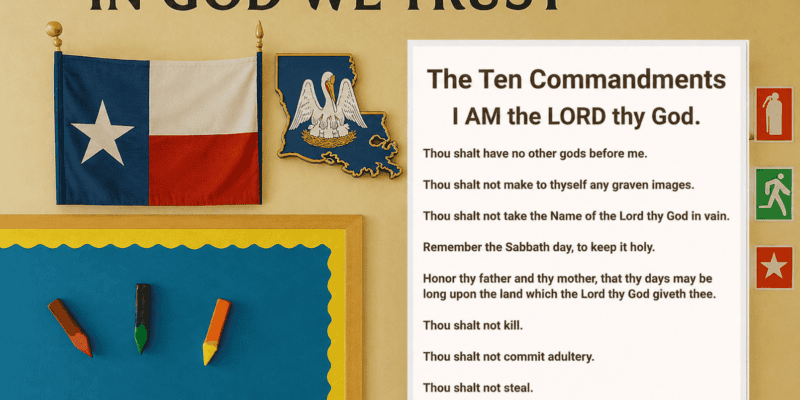
The first two articles of this mini-series were spent exploring the Ten Commandments in ways that may seem unfamiliar to a Catholic, or may seem very familiar to a Catholic if he or she was not taught the Catholic way.
As promised at the end of Part Two, today we close the loop on the series by explaining the Catholic arrangement. Primarily, I’m going to let older and much more authoritative voices do most of the teaching.
First, Saint Augustine, in his Questions on Exodus, 71. The breaking up of the paragraphs is mine, in order to more clarify the reading:
It is asked, in what way the Ten Commandments of the Law are to be divided: whether there are four up to the commandment concerning the Sabbath, which pertain to God Himself, and six that remain, of which the first is, “Honor thy father and mother,”1 which pertain to man; or whether it is more fitting that the former be three, and the latter seven. Indeed those who say the former to be four, separate the commandment, “You shall have have no other gods before me,” that it might be a separate commandment, “You shall not make for yourself an idol,”2 whereby the worshipping of images is prohibited.
However those same wish to combine into one, “You shall not covet your neighbor’s wife; you shall not covet your neighbor’s house,”3 and all the rest up to the end. Certainly those who say the first group to be three, and the second group seven, wish to combine into one whatever is commanded concerning worshipping God, that nothing before God is worshipped. These on the other hand divide the last one into two, that “You shall not covet your neighbor’s house” might be a separate commandment. In neither case is there any doubt that there are Ten Commandments, since Scripture itself testifies to this.
Still it seems to me more fitting that the first group be accepted as three, and the other as seven, because those three which pertain to God seem to make known the Trinity to those diligently contemplating. And truly the commandment, “You shall have no other gods before me,” is itself explicated more completely by the prohibition of worshipping images that follows.
Further on, coveting another’s wife, and coveting another’s house, differ as much in the sins as in the commandments themselves. “You shall not covet your neighbor’s house” might also be joined to other things Scripture says, “Nor his field, nor his manservant, nor his maidservant, nor his ox, nor his ass, nor anything of your neighbor’s.”4 Moreover coveting the wife of another seems to be separate from coveting anything else of another, since both begin thus, “You shall not covet your neighbor’s wife; You shall not covet your neighbor’s house”: both commandments begin with the statement “You shall not covet,” but it is only to the latter that it fastens the other things, saying nor his house, nor his field, nor his servant, and the rest. These all appear to have been joined together and seem to be contained by one commandment, and are separate from that commandment where the wife has been named.
The commandment which says, “You shall have no other gods before me,” appears more devoted to the carrying out of those things which have been placed under it. To what indeed does this pertain, “You shall not make an idol, nor any likeness of anything which is in heaven on high, or anything on earth below, or anything in the sea beneath the earth; you shall not worship them or serve them,”5 unless to the commandment, “You shall have no other gods before me”?
In other words, one must remember the pagan spirit of the age, an age before a Christianity we take for granted, and that these other gods were assumed in the first, including graven images.
That is the Catholic understanding, already plainly argued in the early Church: The image prohibition is included within the First Commandment; coveting another’s wife and coveting another’s goods are the Ninth and Tenth. The Catechism of the Council of Trent, under the First Commandment, of course teaches the same and then addresses the suspicion that Catholics have somehow lost the prohibition against images. That Council occurred in the 1500s, as a response to the Protestant Revolution:
Advertisement
Some, supposing these words which come next in order to constitute a distinct precept, reduce the ninth and tenth Commandments to one. St. Augustine, on the contrary, considering the last two to be distinct Commandments, makes the words just quoted a part of the first Commandment. His division is much approved in the Church, and hence we willingly adopt it. Furthermore, a very good reason for this arrangement at once suggests itself. It was fitting that to the first Commandment should be added the rewards or punishments entailed by each one of the Commandments.
The Above Words Do Not Forbid All Images
Let no one think that this Commandment entirely forbids the arts of painting, engraving or sculpture. The Scriptures inform us that God Himself commanded to be made images of Cherubim, and also the brazen serpent. The interpretation, therefore, at which we must arrive, is that images are prohibited only inasmuch as they are used as deities to receive adoration, and so to injure the true worship of God.
They Forbid Idols And Representations Of The Deity
As far as this Commandment is concerned, it is clear that there are two chief ways in which God’s majesty can be seriously outraged. The first way is by worshipping idols and images as God, or believing that they possess any divinity or virtue entitling them to our worship, by praying to, or reposing confidence in them, as the Gentiles did, who placed their hopes in idols, and whose idolatry the Scriptures frequently condemn. The other way is by attempting to form a representation of the Deity, as if He were visible to mortal eyes, or could be reproduced by colours or figures. Who, says Damascene, can represent God, invisible, as He is, incorporeal, uncircumscribed by limits, and incapable of being reproduced under any shape. This subject is treated more at large in the second Council of Nice. Rightly, then, did the Apostles say (of the Gentiles): They changed the glory of the incorruptible God into a likeness of birds, and of fourfooted beasts, and of creeping things; for they worshipped all these things as God, seeing that they made the images of these things to represent Him. Hence the Israelites, when they exclaimed before the image of the calf: These are thy gods, Israel, that have brought thee out of the land of Egypt, are denounced as idolaters, because they changed their glory into the likeness of a calf that eateth grass.
When, therefore, the Lord had forbidden the worship of strange gods, He also forbade the making of an image of the Deity from brass or other materials, in order thus utterly to do away with idolatry. It is this that Isaias declares when he asks: To whom then have you likened God, or what image will you make for hill? That this is the meaning of the prohibition contained in the Commandment is proved, not only from the writings of the holy Fathers, who, as may be seen in the seventh General Council, give to it this interpretation: but is also clearly declared in these words of Deuteronomy, by which Moses sought to withdraw the people from the worship of idols: You saw not, he says, any similitude in the day that the Lord spoke to you in Horeb, from the midst of the fire. These words this wisest of legislators spoke, lest through error of any sort, they should make an image of the Deity, and transfer to any thing created, the honour due to God.
They Do Not Forbid Representations Of The Divine Persons And Angels
To represent the Persons of the Holy Trinity by certain forms under which they appeared in the Old and New Testaments no one should deem contrary to religion or the law of God. For who can be so ignorant as to believe that such forms are representations of the Deity? forms, as the pastor should teach, which only express some attribute or action ascribed to God. Thus when from the description of Daniel God is painted as the Ancient of days, seated on a throne, with the books opened before hint, the eternity of God is represented and also the infinite wisdom, by which He sees and judges all the thoughts and actions of men.’
Angels, also, are represented under human form and with wings to give us to understand that they are actuated by benevolent feelings towards mankind, and are always prepared to execute the Lord’s commands; for they are all ministering spirits, sent to minister for them who shall receive the inheritance of salvation.
What attributes of the Holy Ghost are represented under the forms of a dove, and of tongues of fire, in the Gospel and in the Acts of the Apostles, is a matter too well known to require lengthy explanation.
They Do Not Forbid Images Of Christ And The Saints
But to make and honour the images of Christ our Lord, of His holy and virginal Mother, and of the Saints, all of whom were clothed with human nature and appeared in human form, is not only not forbidden by this Commandment, but has always been deemed a holy practice and a most sure indication of gratitude. This position is confirmed by the monuments of the Apostolic age, the General Councils of the Church, and the writings of so many among the Fathers, eminent alike for sanctity and learning, all of whom are of one accord upon the subject.
Usefulness Of Sacred Images
But the pastor should not content himself with showing that it is lawful to have images in churches, and to pay them honour and respect, since this respect is referred to their prototypes. He should also show that the uninterrupted observance of this practice down to the present day has been attended with great advantage to the faithful, as may be seen in the work of Damascene on images, and in the seventh General Council, the second of Nice.
But as the enemy of mankind, by his wiles and deceits, seeks to pervert even the most holy institutions, should the faithful happen at all to offend in this particular, the pastor, in accordance with the decree of the Council of Trent’s should use every exertion in his power to correct such an abuse, and, if necessary, explain the decree itself to the people.
He will also inform the unlettered and those who may be ignorant of the use of images, that they are intended to instruct in the history of the Old and New Testaments, and to revive from time to time their memory; that thus, moved by the contemplation of heavenly things, we may be the more ardently inflamed to adore and love God Himself. He should, also, point out that the images of the Saints are placed in churches, not only to be honoured, but also that they may admonish us by their examples to imitate their lives and virtues.
“I am the Lord thy God, mighty, jealous, visiting the iniquity of the fathers upon the children, to the third and fourth generation of them that hate me, and showing mercy unto thousands of them that love me, and keep my commandments.”
In this concluding clause of this Commandment two things occur which demand careful exposition. The first is, that while, on account of the enormous guilt incurred by the violation of the first Commandment, and the propensity of man towards its violation, the punishment is properly indicated in this place, it is also attached to all the other Commandments.
Every law enforces its observance by rewards and punishments; and hence the frequent and numerous promises of God in Sacred Scripture. To omit those that we meet almost on every page of the Old Testament, it is written in the Gospel: If thou wilt enter into life, keep the commandments; and again: He that doth the will of my Father who is in heaven, he shall enter into the kingdom of heaven; and also: Every tree that doth not yield good fruit shall be cut down and cast into the fire; Whosoever is angry with his brother shall be guilty of the judgment; If you will not forgive men, neither will your Father forgive you your offences.
Finally we have the plain language intended for children and those with an underdeveloped education on Catholicism. The Baltimore Catechism, no. 3, Q. 220, says:
The first commandment forbids the making or the use of statues and pictures only when they promote false worship.
Its questions on the Ninth and Tenth name them separately: “Thou shalt not covet thy neighbor’s wife” and “Thou shalt not covet thy neighbor’s goods.”
Now look again at the Louisiana classroom text or its Texas counterpart. Read the historical background placed first and second in this mini-series if you’d like. The words against graven images are there, but the poster indicates no numbers. The arrangement wouldn’t matter so much if the number of non-Catholics didn’t blast away at Catholics for supposedly “worshipping” statues and images, which is why we produced this mini-series at all, which is why it is important that a Catholic child be prepared for these types of unfortunate assaults from non-Catholic peers. It may not be the majority of them, but all it takes is one. Catholic children need someone at home to tell them how the Church has precisely taught him to see the Commandments—and, more importantly, what those commandments ask of his soul.
Thank you for reading The Hayride!
Advertisement
Advertisement
