
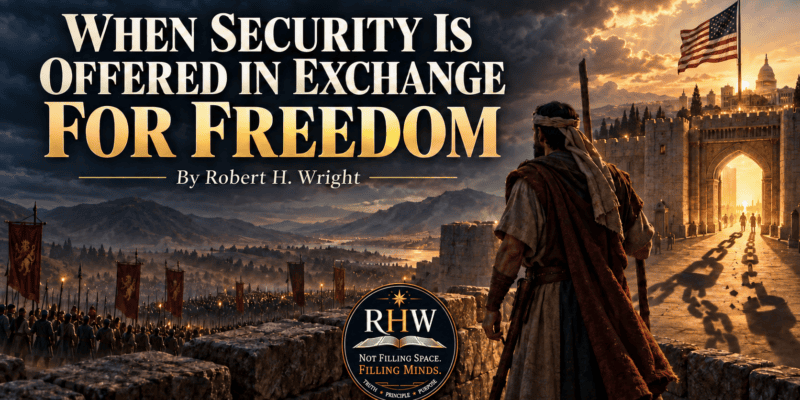
The most dangerous attacks on freedom do not always arrive with armies. Sometimes they arrive wrapped in promises—promises of protection, peace, prosperity, and relief.
The message is always attractive: Give us more power, and we will make you safe. Surrender a little freedom, and we will remove your fear. Stop resisting, and life will become easier.
Isaiah 36 records one of history’s clearest examples of this deception.
The Assyrian army had invaded Judah, conquered its fortified cities, and surrounded Jerusalem. Assyria’s representative, the Rabshakeh, called to the people standing on the city wall. He urged them to reject King Hezekiah and surrender:
“Make an agreement with me by a present, and come out to me: and eat ye every one of his vine, and every one of his fig tree, and drink ye every one the waters of his own cistern.”
It sounded like peace. The siege would end. The people could return to their homes, eat from their vines, and drink from their wells.
Then came the words that exposed the trap:
“Until I come and take you away to a land like your own land.”
“Until I come and take you away.”
Assyria was not offering freedom. It was offering a brief period of comfort before captivity. The people could enjoy their homes temporarily, but Assyria would decide their future. They would be removed from their land, separated from their heritage, and placed under the control of a foreign empire.
The Rabshakeh was not promising to preserve their liberty. He was trying to make surrender feel painless.
That warning should thunder across the United States today.
The Ancient Bargain
Throughout history, those seeking greater control have used fear to persuade people to surrender their freedom. The threat may be foreign attack, crime, economic collapse, disease, misinformation, civil disorder, or some other crisis. The message remains the same:
You are in danger. We alone can protect you. Give us the authority we demand.
Government has a legitimate duty to defend the country, punish wrongdoing, and protect innocent life. But fear must never become a blank check for unlimited power.
The question is not merely what a proposal promises today. The question is what powers it creates for tomorrow.
It is not enough to ask whether we trust the leaders currently holding authority. We must ask whether we would trust their opponents with that same authority. A government power applauded when used against someone we dislike can later be turned against us.
Benjamin Franklin recognized this danger more than 270 years ago. In 1755, he warned:
“Those who would give up essential Liberty, to purchase a little temporary Safety, deserve neither Liberty nor Safety.”
Franklin’s warning was not an argument against every reasonable measure intended to protect the public. It was a warning against surrendering essential liberty in exchange for the promise of temporary safety. Security purchased by abandoning fundamental rights may prove temporary, while the power surrendered to government may become permanent.
That is why constitutional limits matter.
Freedom cannot depend upon the goodwill of whoever occupies a government office. It must be protected by firm boundaries that remain in place regardless of which party is in power.
Temporary Powers Have a Way of Becoming Permanent
The people of Jerusalem were told that their surrender would bring immediate relief. Their captivity would come later.
This is how liberty is often lost—not all at once, but in stages. First comes the emergency. Then comes the demand for extraordinary authority. The power is described as necessary and temporary. The crisis passes, but the power remains.
Each surrender is presented as small and reasonable. Each restriction is defended as being for the public good. Each expansion of authority becomes the justification for the next.
One freedom is surrendered to prevent violence. Another is weakened to control supposedly dangerous speech. Privacy is reduced in the name of security. Due process is treated as an inconvenience. Citizens are told that if they have done nothing wrong, they have nothing to fear.
But innocent people have the most to lose when government operates without restraint.
The Constitution was not written only for peaceful times when protecting rights is easy. It was designed for dangerous times, when fear makes the abandonment of liberty appear reasonable.
A Comfortable Captivity Is Still Captivity
The Rabshakeh described the land of exile as a place with grain, bread, vineyards, and wine. His message was that losing their homeland would not matter as long as their material needs were met.
In other words: You may not be free, but you will be comfortable.
America faces that same temptation.
A nation can possess wealth, food, entertainment, technology, and government benefits while its citizens steadily lose control over their lives. People can be materially comfortable while becoming increasingly monitored, censored, regulated, and dependent.
Prosperity is not the same as liberty.
A comfortable prison is still a prison. A golden chain is still a chain. And a government powerful enough to provide everything its citizens desire may eventually become powerful enough to take everything they possess.
Dependence also creates control. When people depend completely upon a central authority for their income, housing, healthcare, education, information, or basic security, challenging that authority becomes increasingly difficult.
Assistance should help people regain independence—not convert citizens into permanent dependents who are afraid to disobey those distributing the benefits.
The Price Hidden Behind the Promise
The Assyrian spokesman emphasized what the people would receive immediately: their vines, their fig trees, and their wells. He minimized what they would eventually lose: their homes, their country, their identity, and their freedom.
America must learn to read beyond the promise.
When authorities demand additional power, citizens should ask:
- What freedom must we surrender?
- Who will control this power?
- What prevents it from being abused?
- Can citizens challenge it in court?
- When will the authority expire?
- Will the freedom ever be restored?
- Would we support this power if our political opponents controlled it?
- What kind of country will this leave our children?
These questions are not signs of rebellion. They are the responsibilities of citizenship in a constitutional republic.
People who value freedom do not oppose every security measure. They insist that security measures be necessary, lawful, limited, transparent, and accountable.
Fear Is the Enemy of Discernment
The Rabshakeh wanted the people frightened. Fear would cause them to stop thinking, distrust their leaders, doubt their God, and surrender without resistance.
Fear still performs the same work today.
A frightened population can be manipulated into accepting restrictions that a calm and thoughtful population would reject. When every disagreement is called a crisis and every crisis demands additional government power, emergency itself becomes a method of government.
Americans must refuse to be governed by panic.
We must examine facts, question sweeping claims, demand constitutional accountability, and reject the idea that freedom is an obstacle to safety. Most importantly, we must place our confidence in God rather than in human institutions that promise complete security but can never provide it.
The Watchman Must Sound the Alarm
Freedom is rarely destroyed in one dramatic act. It is usually surrendered gradually—one fear, one promise, one emergency, and one “temporary” restriction at a time.
The people are told not to worry. The sacrifice will be small. The power will be used responsibly. The restrictions will end soon.
Then one day, they discover that temporary authority has become permanent control.
The watchman’s duty is to recognize the danger before the gates are opened. It is not enough to sound the alarm after the walls have fallen.
America must resist the false choice between complete insecurity and unlimited government power. We can protect our nation without abandoning our Constitution. We can enforce the law without destroying due process. We can defend public order without silencing lawful disagreement. We can help people in need without making them servants of the state.
But doing so requires courage, wisdom, and vigilance.
Isaiah 36 warns us that the promise of immediate relief may conceal the plan for eventual captivity. The words spoken outside Jerusalem still confront every free people:
Surrender now. Enjoy your comfort today. Do not worry about what we will take from you tomorrow.
America must look beyond the offer and count the true cost.
Security without freedom is not safety. It is control.
Prosperity without freedom is not success. It is comfortable servitude.
Peace purchased by surrender is not peace. It is merely captivity waiting for its appointed hour.
Before America accepts any promise of security, we must listen for the words hidden behind it:
“Until I come and take you away.”
Advertisement
Advertisement
