(This article originally appeared on the Louisiana First Standard substack)
MAN OF THE PEOPLE VS. THE CORPORATE ELITES
As November 3 approaches, a locally raised school board member faces a well-connected challenger in a race that has become a larger debate about political influence, taxpayer accountability, and who really controls Jefferson Parish public education.
For the past nine months, Jefferson Parish School Board Member Michael Pedalino has found himself in an intense political battle of his early career as an elected official.
The irony? Pedalino believes his biggest political problem isn’t with the people he represents. It’s with some of Jefferson Parish’s most influential business leaders.
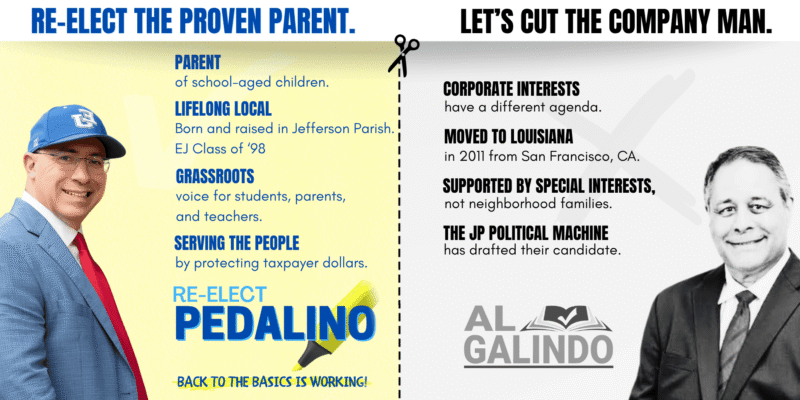
A lifelong local resident and graduate of East Jefferson High School, Class of 1998, Pedalino has built his reputation as an independent voice willing to challenge the administration, question spending proposals, and take positions that sometimes put him at odds with fellow board members.
Now, the small-business owner, business consultant, and father of three is seeking a second term against Al Galindo, a challenger backed by the Jefferson Chamber of Commerce PAC and Committee for Better Jefferson. Pedalino sees the contest as another chapter in a familiar story: grassroots voters versus the political establishment. Let’s call it Round 2. The voters will decide on November 3.
The Shadow Board Member
One of the more unusual dimensions of this race involves Larry Dale, the executive director of the Jefferson Business Council and a former three-term school board member who once represented the same District 6 seat Pedalino now occupies.
Although Dale no longer serves on the board, he remains engaged in school board affairs.
Pedalino has given his predecessor a nickname: the “Shadow Board Member.” The nickname reflects Pedalino’s concern about the influence of former officeholders and politically connected business organizations over decisions made by today’s elected representatives.
The broader question is whether the Jefferson Business Council’s involvement in education policy represents ordinary civic advocacy or an effort to preserve influence over the school system. Pedalino argues that the answer can be found in two contentious policy battles.
Battle Number One: Airline Park Aftercare
One of Pedalino’s more controversial initiatives involved the aftercare program at Airline Park Academy.
Pedalino authored a motion to increase weekly aftercare tuition from $35 to $45 and raise hourly compensation for aftercare workers from $8.50 to $13.50 without increasing property taxes. This was because Pedalino was serving parents and addressing their desperation for aftercare at Airline Park when the system couldn’t get workers who could make more money door-dashing.
The administration raised concerns that higher tuition would create financial difficulties for lower-income families. Pedalino saw the issue differently. He argued that employees caring for children deserved better compensation and that the program needed a more sustainable financial structure.
According to figures Pedalino cites, registration declined significantly after the change, but the utilization rate remained stable, and participating schools received more revenue. Those figures warrant closer examination, particularly the distinction between registration and actual attendance. Still, the dispute illustrated Pedalino’s willingness to pursue a policy opposed by administrators. For Pedalino, the issue was about ensuring that aftercare workers were fairly compensated while making the program financially sustainable.
Battle Number Two: The Electric School Bus Showdown
If aftercare created friction, electric school buses turned that friction into a political confrontation.
In November 2025, the Jefferson Parish School Board considered an EPA-backed electric school bus proposal involving approximately $7 million in federal funding and a proposed $3.1 million local commitment. Board Member Clay Moise sponsored the administration-backed motion. Pedalino opposed the proposal, questioning its cost, operational reliability, and long-term financial implications for taxpayers.
The debate became one of the most contentious board disputes of the year.
When the votes were counted, the proposal failed 6–3. Pedalino emerged as one of the leading voices against the plan, and the outcome became a centerpiece of his campaign’s taxpayer-watchdog message. For supporters, the vote demonstrated that an individual board member could challenge an administration recommendation and help persuade a majority of colleagues. For critics, opposition to the buses meant passing up a substantial federal investment in the district’s transportation system.
But the political consequences of that November vote extended well beyond electric buses.
Enter Al Galindo: Dale and Moise Strike Back!
In 2026, Al Galindo announced his candidacy for the District 6 school board seat. Galindo, who has California roots, entered the race against a locally raised incumbent with longstanding community ties.
The Jefferson Chamber of Commerce PAC subsequently endorsed Galindo. That endorsement attracted attention because Galindo previously served on the Chamber PAC’s own board of directors. But the PAC endorsement raises a broader question.
Why would a business-oriented political organization favor Galindo over Pedalino, who is himself a Jefferson Parish small-business owner?
The Chamber PAC may have concluded that Galindo better represents its preferred approach to school governance, business engagement, or district policy. An endorsement alone does not establish improper coordination or corporate control. Still, voters deserve to know what criteria led to that endorsement, how the PAC addressed Galindo’s previous leadership role, and whether differences over school administration policy influenced its decision.
Pedalino maintains that the school board must answer first to parents, teachers, students, and taxpayers—not to any outside business organization.
Tango and Cash: An Unfortunate School Board Political Drama
The political conflict has also created tension between Pedalino and fellow Board Member Clay Moise. Moise and Pedalino were on opposing sides of the electric school bus vote and aftercare. The battles were intense. Pedalino has since criticized what he views as political efforts by Moise and Dale to undermine his reelection by drafting Galindo. Someone who will serve is ‘their vote’ vs. being ‘the voice’ of District 6.
The relationship has become so contentious that Pedalino now jokingly calls the two men “Tango and Cash,” two tough cops who go after the ‘bad guy’ in the 1989 action movie. But beneath the humor are serious questions about relationships on the board.
According to campaign finance disclosures, Clay Moise contributed $6,000 to Galindo’s campaign; the contribution would be a striking example of one sitting school board member financially supporting a challenger to a fellow board member. Sources have also told Pedalino that Moise criticized him as selfish and self-serving during a Republican executive committee endorsement process. Sources said the delivery was very hostile. “Moise should have dressed like Rambo coming into that Saturday Morning meeting; he was clearly out for political blood,” Pedalino says.
That was in August; now, in October, as early voting is underway, a personal smear campaign against Pedalino has been launched by a shadow or dark PAC called Third Coast United. (This PAC is so dark, the entity cannot be located) The hit piece questioned Pedalino’s integrity and ethics for attending a dinner by an insurance vendor. The irony is Pedalino voted “NO” on that same vendor fighting for a local agency vs. a national firm back in January 2025. Interesting how they leave out the details.
Did Tango and Cash run this smear operation in a desperate attempt to save a campaign that’s having such a hard time connecting with voters on the issues?
Those circumstances invite difficult questions:
- How can a school board maintain productive working relationships when one member financially supports an opponent seeking to unseat a colleague?
- Was the dispute driven by substantive policy disagreements, including the electric school bus vote, or by broader differences over leadership and governance?
- What role, if any, have former board members and business organizations played in recruiting or supporting Pedalino’s opposition?
- Can the board move beyond personal political disagreements after the November election?
Pedalino has expressed confidence that a second term could bring a different working environment, particularly with changes in board membership expected in January 2027. I think Clay Moise moving on from the board will help bring unity, Pedalino says. He acts like a ‘bully’ when things don’t go his way, and most colleagues would agree, he continued.
Regardless of the election outcome, Jefferson Parish families have an interest in seeing their elected representatives work together professionally.
A Different Kind of Endorsement Battle
Pedalino has endorsements from the Jefferson Parish Republican Parish Executive Committee, Greater New Orleans Republicans, the Alliance for Good Government, and the Jefferson Federation of Teachers. A ‘unified coalition.’ Not to mention, Gov. Jeff Landry, who endorsed Pedalino before qualifying.
Galindo has received endorsements from the Jefferson Chamber PAC and Committee for a Better Jefferson.
Wise people can connect the dots on these endorsements to see who their District 6 representative will serve come January 2027. Man of the People vs. The Corporate Candidate.
Born Here. Raised Here. Educated Here.
Pedalino’s personal history is central to his campaign. He grew up in Jefferson Parish, attended its public schools, and graduated from East Jefferson High School. He built a successful career in sales, business ownership, and consulting before winning his first school board election in 2022. He is now seeking another four years representing the community where he was raised.
His campaign contrasts that history with Galindo’s California background and corporate connections. But the issue is bigger than where either candidate was born.
The real question is who understands the district, who has earned the community’s trust, and who will exercise independent judgment once elected.
Pedalino believes his first term supplies the answer. He points to his work on employee compensation, aftercare, taxpayer oversight, school transportation, and other local issues as evidence of a record grounded in constituent concerns.
November 3: Who Gets the Final Say?
The District 6 election has become a referendum on competing visions of school board leadership. Should board members generally support the administration’s recommendations to maintain organizational consistency? Or should they aggressively challenge those recommendations, even when doing so creates tension with colleagues and influential community organizations?
Pedalino has made his choice clear. He believes an elected school board member’s primary responsibility is to the public, not to any political or business establishment. His opponent and supporters have an opportunity to make their own case for how District 6 should be represented.
Ultimately, neither the Jefferson Business Council, the Chamber PAC, nor any political endorsement organization gets the final vote. The people of District 6 do.
On November 3, voters will determine whether Pedalino’s independent approach has earned another four years. And whatever the result, this race has already exposed a question that reaches far beyond one school board seat:
Who should have the greatest influence over Jefferson Parish public schools—the elected representatives accountable to voters, the administration responsible for operating the system, or the powerful organizations seeking a voice in its future?
The answer should begin and end with the people.
Advertisement
Advertisement
