
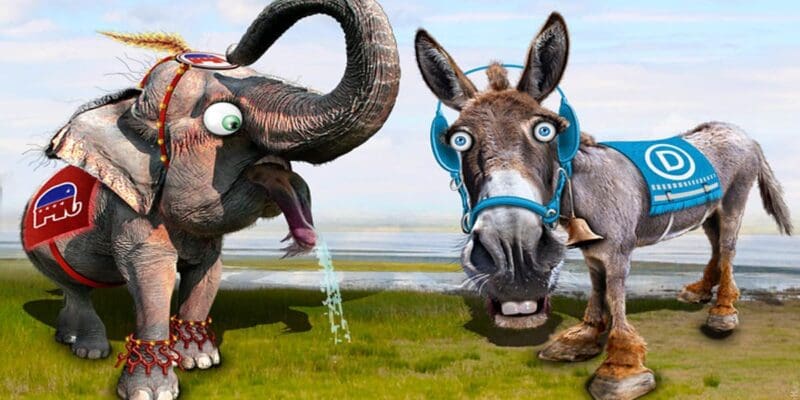
Lots of Republicans are upset that nothing much has been achieved in Congress since Trump’s re-election in 2024 aside from the Big Beautiful Bill. For the gatekeepers of the Republican Party (and the Democrat Party), that’s precisely the point: Create the illusion for voters that their participation in the system is making a difference, while making no real effort to reform the system from one that doles out favors to wealthy and powerful interests to one that focuses on benefitting the good of every citizen.
Political parties also tend to spread corruption in other ways. Uber Yankee John Adams gave a sharp warning:
‘There is nothing I dread So much, as a Division of the Republick into two great Parties, each arranged under its Leader, and concerting Measures in opposition to each other. This, in my humble Apprehension is to be dreaded as the greatest political Evil, under our Constitution’ (Michael Boldin, ‘The Top-5 Tools of Tyranny,’ tenthamendmentcenter.com).
The Scottish political writer Thomas Gordon (died 1750) explains why political parties are so much ‘to be dreaded’:
‘It is with Measures as with Men; they are praised, or condemned, not because they are Right or Wrong, Beneficial or Hurtful, but because they come from this Party, or the other. Evil is turned into Good, and Good into Evil: Truth passes for Falsehood; Falsehood is dressed up in the Guise of Truth: The best Actions are decried as the worst, if they arise from one Quarter; the worst Actions adored as the best, if from the other’ (Ibid.).
And Dixie’s own George Washington adds his own warning against them, showing how they often end in despotism:
‘The alternate domination of one faction over another, sharpened by the spirit of revenge natural to party dissension, which in different ages and countries has perpetrated the most horrid enormities, is itself a frightful despotism. But this leads at length to a more formal and permanent despotism. The disorders and miseries which result gradually incline the minds of men to seek security and repose in the absolute power of an individual; and sooner or later the chief of some prevailing faction, more able or more fortunate than his competitors, turns this disposition to the purposes of his own elevation on the ruins of public liberty’ (Farewell Address, senate.gov).
Discontentment with the two familiar political parties in DC has manifested in different ways over the years: from the Tea Party to Occupy Wall Street, from MAGA to the Democratic Socialists of America. The need to weaken their influence in the federal government for the sake of the common good is glaringly obvious. But the result has been the same each time: Whatever genuine reforming energy there was within any of them got co-opted by Establishment minions at some point, and they now exist to serve the very parties they were brought into existence to disrupt.
Different approaches are therefore needed to accomplish that goal. More specifically, two structural changes to the federal government should be considered toward that end.
The United States Senate since the approval of the 17th Amendment in 1913 (which changed the mode of selecting senators from election by the State legislatures to direct election by the voters of the States) has seen a steady degradation in the quality of her members. Once there were great orators and leaders like John Randolph, Daniel Webster, John Calhoun, Jefferson Davis, Henry Clay, and others. Now we are forced to endure the mediocrities and worse of Mitch McConnell, Liz Warren, Tom Cotton, Maria Cantwell, Richard Durbin, et al.
The method of choosing federal senators has contributed to this decline, as it has changed their role in the constitutional structure. Prior to the 17th Amendment, they served in Fisher Ames’s words as ‘ambassadors of the states’ (spoken at the Massachusetts Ratifying Convention), who would serve to protect the independence and authority of their respective States from federal encroachments. Oliver Wolcott confirmed this view at the Connecticut Ratifying Convention: ‘The Senate . . . are appointed by the states, and will secure the rights of the several states.’ St George Tucker of Virginia likewise affirmed, ‘the senate are chosen to represent the states in their sovereign capacity’ (Ralph Rossum, Federalism, The Supreme Court, and the Seventeenth Amendment: The Irony of Constitutional Democracy, Lexington Books, Lanham, Maryland, 2001, pgs. 103, 105).
Both the method of choosing the senators (which was separated from the demagogic rigmarole of campaigns) and the understanding of their duties as ambassadors of their States and guardians of their interests, even of their State’s continued existence, helped to ensure that the US Senate became a truly aristocratic body (rule by the best, virtuous few) rather than an oligarchic one (rule by a corrupt, selfish few).
Advertisement
Now that federal senators post-17th Amendment have become simply another kind of elected official representing and being funded by the major donors and powerful interests across the United States that hide behind and direct the Republican and Democrat parties, they have taken on the perverse character of the Deep State whom they serve.
Thus, for the Senate, a key reform is to repeal the 17th Amendment and return the selection of US senators to the State governments.
As for the US House of Representatives, it is supposed to be the more democratic part of the Congress. Yet Aristotle reveals something about democratic elections in his Politics that will likely startle many people: ‘ . . . the appointment of magistrates by lot is democratical, and the election of them oligarchical’ (IV, 9, 4, Benjamin Jowett translation, Dover Publications, Mineola, New York, 2000, p. 165).
We have had it backwards for decades here in the US: Elections yield oligarchy, not democracy. This goes far in explaining why elections bring disappointing results year after year. The alternative also makes sense: Selection of representatives by lot bypasses the whole scheming, corrupt system of party loyalties, insider connections, dark money, negative lying ads, etc. Political campaigns would be rendered completely unnecessary if representatives were chosen by lot. Actual outsiders would stand a good chance of being seated in the Congress. The views of plain ol’ working folks and Christian families would likely be voiced in the House at long last, and many of the phony play-actors who pretended to do so would be excluded.
The concept of choosing representatives by lot has been tried and proven over many centuries with the jury trial: The members of juries are gathered by random selection, and justice has not suffered because of it. It has rather been protected from the whims and caprices of judges by the existence of a jury of a defendant’s peers. We ought to expect similar good results from US representatives being chosen by lot. Terry Hulsey’s book – The Constitution of Non-State Government: Field Guide to Texas Sortition, published by Shotwell Press – as well as his articles at the Abbeville Institute web site go into more detail for those who want to explore the subject more in depth.
The spiritual state of the peoples of the States is of supreme importance. If they are spiritually ill and disordered, external shuffling of the government apparatus will be of little value in the long run. To the extent that our folks do retain some residual amount of spiritual health, we heartily recommend these two changes to the federal government to bypass and disrupt the corrupt party system – the repeal of the 17th Amendment and the selection of senators by the State governments and the selection of House members by lot.
Advertisement
Advertisement
