
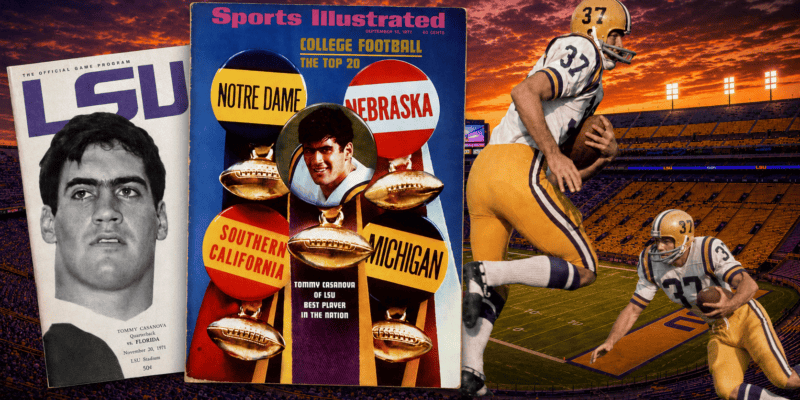
Before LSU became DBU, before ex-Colorado Buffalo and Pittsburgh Steeler star Kordell Stewart was nicknamed “Slash,” before the multiple position superstardom of Patrick Peterson, Mo Claiborne, and Tyrann Mathieu, the best player in college football was already an LSU defensive back.
And the original LSU version of Slash was never merely that.
Born July 29, 1950, now-Doctor Tommy Casanova was something LSU football may never produce again—not simply a great player, but one for whom modern specialization has no adequate comparison. Although LSU lists him historically at cornerback, understanding Casanova requires an inventory of everything else he did.
That career nearly happened somewhere else. Recruited by only three schools, Casanova was leaning toward Tulane even though the Green Wave were not recruiting him. Nelson Stokley, LSU’s senior quarterback and Casanova’s friend from Crowley, convinced him that he belonged in Baton Rouge.
During his three varsity seasons from 1969–71, Casanova played defensive back, halfback, and punt and kickoff returner. He also competed on LSU’s track team. Having rushed 72 times across his first two seasons, he averaged 4.2 yards per carry while continuing to handle his defensive responsibilities. According to one story Charlie McClendon later told, Casanova once completed a Saturday football scrimmage, showered, ate supper, and began studying before LSU summoned him to replace an injured runner on the track team. Casanova arrived and helped win the relay.
“Tommy was one of the most gifted athletes I ever coached,” McClendon said. “There’s no question in my mind he could’ve been an All-American running back. He could really have jazzed up our offense.”
It is difficult to imagine a current coach allowing one of the country’s best defensive backs to attempt any part of that lineup.
In his first nationally televised game, Casanova also made a fourth-down tackle behind the line inside LSU’s five-yard line, helping preserve a 21–20 victory over top-10 Auburn and giving the country its first extended look at the future All-American.
While Casanova’s versatility was evident throughout his career, his defining performance came against Ole Miss in 1970. With the SEC championship and an Orange Bowl invitation still available, he returned punts 61 and 73 yards for touchdowns, tying an NCAA record and helping LSU embarrass the Rebels, 61–17.
“We beat Ole Miss like a drum that game,” Casanova said. “Archie Manning had broken his arm two weeks before, and he had a ridiculous cast. It seemed like everything went right for us that game and everything went wrong for them. We weren’t that much better; it was just that the pieces fell into place.”
That SEC title would be the last one until 1986, when Coach Bill Arnsparger led the Tigers to the crown.
Advertisement
By the following summer, Sports Illustrated had found their man. Casanova appeared on the cover of its 1971 college football preview beneath a declaration almost unimaginable in today’s quarterback-dominated sport: “Best Player in the Nation.”
The cover appeared to position Casanova for a serious Heisman Trophy campaign, but a pulled hamstring in the second game sidelined him for five weeks, removing him from the race while allowing teammate Bert Jones to emerge as LSU’s next national star. Despite the injury, Casanova still completed his career as the only three-time first-team All-American in LSU history.
RELATED
SALUTE TO SEVEN: Bert Jones and the 1972 Ole Miss Ghost Lane Kiffin Inherits
His life after LSU somehow followed the same refusal to fit into a single category. Casanova played six seasons for the Cincinnati Bengals, becoming a three-time Pro Bowler and first-team All-Pro. While competing in the NFL, he earned his medical degree during the off-seasons, eventually leaving football and returning to Crowley as an ophthalmologist.
Soon, Casanova and Jones will be reunited inside Tiger Stadium. When LSU announced that Jones’ No. 7 would be retired this November, Jones said one of the most special parts would be seeing his name displayed alongside that of his former roommate, Tommy Casanova, whose No. 37 has occupied the stadium façade since 2009.
We understand that there were other players key to LSU’s success, don’t get us wrong. But sometimes the stories write themselves.
Long before LSU began filling rosters with defensive backs to the NFL, Tommy Casanova supplied the prototype. Yet even “DBU” seems too narrow for him, for he was not merely LSU’s best defensive back. For a time, he was considered the best football player in America—all positions included.
—
Thank you for reading The Hayride!
Advertisement
Advertisement
