
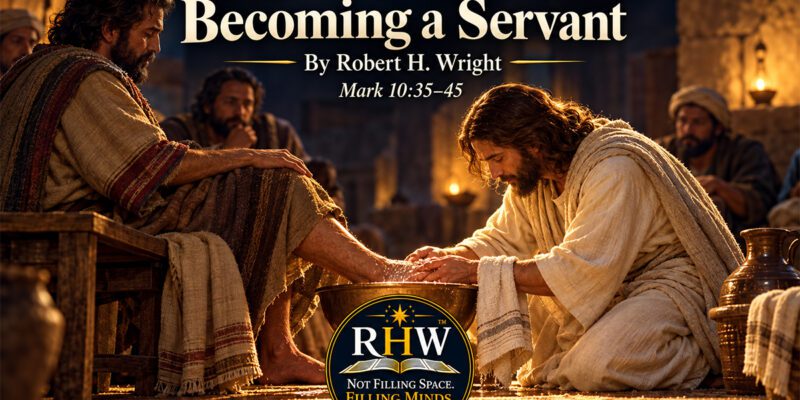
Power reveals whether a leader came to serve the people—or to be served by them.
Will those who seek leadership use their position to serve the people who entrusted it to them? Or will the people become a means to protect their position?
As Americans prepare to vote on November 3, Christians should ask those questions of our leaders. But we must also be willing to ask them of ourselves.
The desire for recognition does not stop at the doors of a church. Even in Christian service, we can begin measuring success by how many people know our names rather than how faithfully we honor Christ.
In Mark 10:35–45, Jesus confronts that temptation among His own disciples. His words challenge every believer who has ever confused being important with being faithful.
James and John approached Jesus with a request:
“Master, we would that thou shouldest do for us whatsoever we shall desire.”
—Mark 10:35, KJV
Before explaining what they wanted, they sought His agreement. How often do our prayers follow that same pattern? We bring God our plans and ask Him to approve them, assuming that what we desire must also be what He intends.
The brothers wanted places of honor—one at Jesus’ right hand and the other at His left in His glory.
They believed in His greatness. But they had not yet understood what following Him would require.
Seeking a Throne While Jesus Approaches a Cross
The setting makes their request especially sobering.
Just before this conversation, Jesus had told His disciples that He would be betrayed, condemned, mocked, scourged, and killed. He also told them He would rise again.
Jesus was speaking about sacrifice. James and John were thinking about status.
Their request exposes a danger that remains with us: We can hear the words of Christ while resisting the shape of the life He calls us to live.
We may want the blessings of discipleship while avoiding its cost. We may seek opportunities to lead while overlooking opportunities to serve.
Jesus answered that they did not understand what they were asking. Could they drink His cup and undergo His baptism?
The cup and baptism point to the suffering He would endure. The brothers quickly answered that they could. Jesus told them they would indeed share in suffering, but the places they requested were not His to grant; they belonged to those for whom they had been prepared.
Faithfulness would involve hardship. It would not give them control over their reward.
Obedience is not a bargain in which we serve God so that He must grant us prominence.
The Problem Was Bigger Than Two Brothers
When the other ten disciples heard what James and John had requested, they became indignant.
We should be cautious about assuming their anger proved greater humility. Earlier in Mark, the disciples had argued over who was greatest. Ambition was a problem among them, not merely between these two brothers.
Jesus called them together and addressed the entire group.
He described rulers who exercised dominion over others and powerful men who imposed their authority. Then He drew a clear boundary:
“But so shall it not be among you.”
—Mark 10:43, KJV
His followers were to practice a different kind of leadership.
Authority would not excuse arrogance. Position would not justify mistreatment. Leadership would carry responsibility for the people entrusted to their care.
As an elected constable, I understand that a public office carries duties that must be taken seriously. The people we serve deserve to be treated with dignity, even when the circumstances are difficult. Holding a title does not make anyone more valuable than the people who come before him.
The same principle applies in the church and at home. A pastor, a parent, or an elected official may have authority, but each must answer for how that authority is used.
This does not mean leaders must abandon conviction, discipline, or difficult decisions. A parent sometimes must correct. A pastor sometimes must confront sin. A public official sometimes must enforce the law.
But none of those duties permits contempt for the people being served.
The question is whether we exercise authority for their good or use them to satisfy our pride.
As we consider candidates this election season, policies and qualifications matter. So does character. We should pay attention to whether those seeking office understand that the position carries an obligation to serve.
And we should apply that same standard to ourselves. It is easier to criticize pride in a public figure than to recognize it in our own hearts.
Greatness That God Recognizes
Jesus taught that whoever desired greatness must become a minister—a servant—and whoever desired to be first must become the servant of all.
That teaching reaches beyond pulpits and public office. It enters our homes, workplaces, congregations, and daily conversations.
It asks whether we will do necessary work when someone else receives the credit. Whether we will listen to someone who cannot advance our interests. Whether we will admit a mistake, keep a promise, or help a struggling person when nobody is watching.
Service is often inconvenient. It interrupts our schedules and exposes our impatience. It requires us to recognize that other people’s needs matter even when meeting them brings us no advantage.
Yet Jesus does more than command this way of life. He points to Himself:
“For even the Son of man came not to be ministered unto, but to minister, and to give his life a ransom for many.”
—Mark 10:45, KJV
This is the heart of the passage.
Jesus did not come merely to offer an inspiring example of kindness. He came to give His life to redeem sinners. His death accomplishes what our service never could: Our good works cannot purchase our freedom from sin.
We serve because of the Savior who gave Himself for us.
James and John asked for seats beside a glorious King. Jesus directed their attention toward the sacrifice that revealed His mission.
His words still confront our ambitions today.
Before asking God to give us a greater position, perhaps we should ask Him to make us more faithful in the responsibilities already before us.
The next opportunity for greatness may be an unnoticed act of service.
And the person we need to serve may already be standing beside us.
Advertisement
Advertisement
