

Bert Jones is a legend in the history of LSU football, and on Wednesday, the university made official what many Tiger fans believed should have happened long ago.
Jones, the “Ruston Rifle” and the first All-American quarterback in LSU history, will have his No. 7 jersey retired on November 14 when LSU hosts Texas in Tiger Stadium. The LSU Athletic Hall of Fame Committee approved it unanimously, and Jones’ jersey will join Billy Cannon’s No. 20, Tommy Casanova’s No. 37, Jerry Stovall’s No. 21, and Charles Alexander’s No. 4 on the south end zone façade.
Jones and Casanova, a defensive back and return specialist, played together from 1969-71, and are both members of the College Football Hall of Fame. Casanova, who remains the only three-time first-team All-American in Tiger history, had his jersey retired 17 years ago.
After a stellar college playing career, Jones was selected No. 2 overall in the 1973 NFL Draft by the Baltimore Colts. During his 10-year NFL career, Jones appeared in 102 games with 96 starts. He led the Colts to an 11-3 regular-season mark in 1976, and as a result, was named NFL MVP.
“I had no idea that there was anything in the works so this is totally unsuspecting,” Jones said. “I have been the beneficiary of a lot of good things and received a lot of accolades and a lot of awards, but this is at the top of the list.”
The school also noted an important distinction that is of significance to more recent LSU football tradition: All of those numbers except Cannon’s No. 20 are still worn by current players, so this is the retirement of Jones’ jersey, not the burial of No. 7 itself.
Only a few days ago, we were writing about Patrick Peterson, Tyrann Mathieu, Whit Weeks, and the modern meaning of LSU’s No. 7. In the current conversation on LSU football, No. 7 has become the playmaker number. Peterson is considered the initiate, even though linebacker Ali Highsmith was quite the playmaker himself in the 2007 championship season. Mathieu legitimized the yearly transfer. Leonard Fournette, DJ Chark, Grant Delpit and others helped carry it into the yearly summer conversation, to varying degrees of course, where fans now wonder who will be granted the honor next.
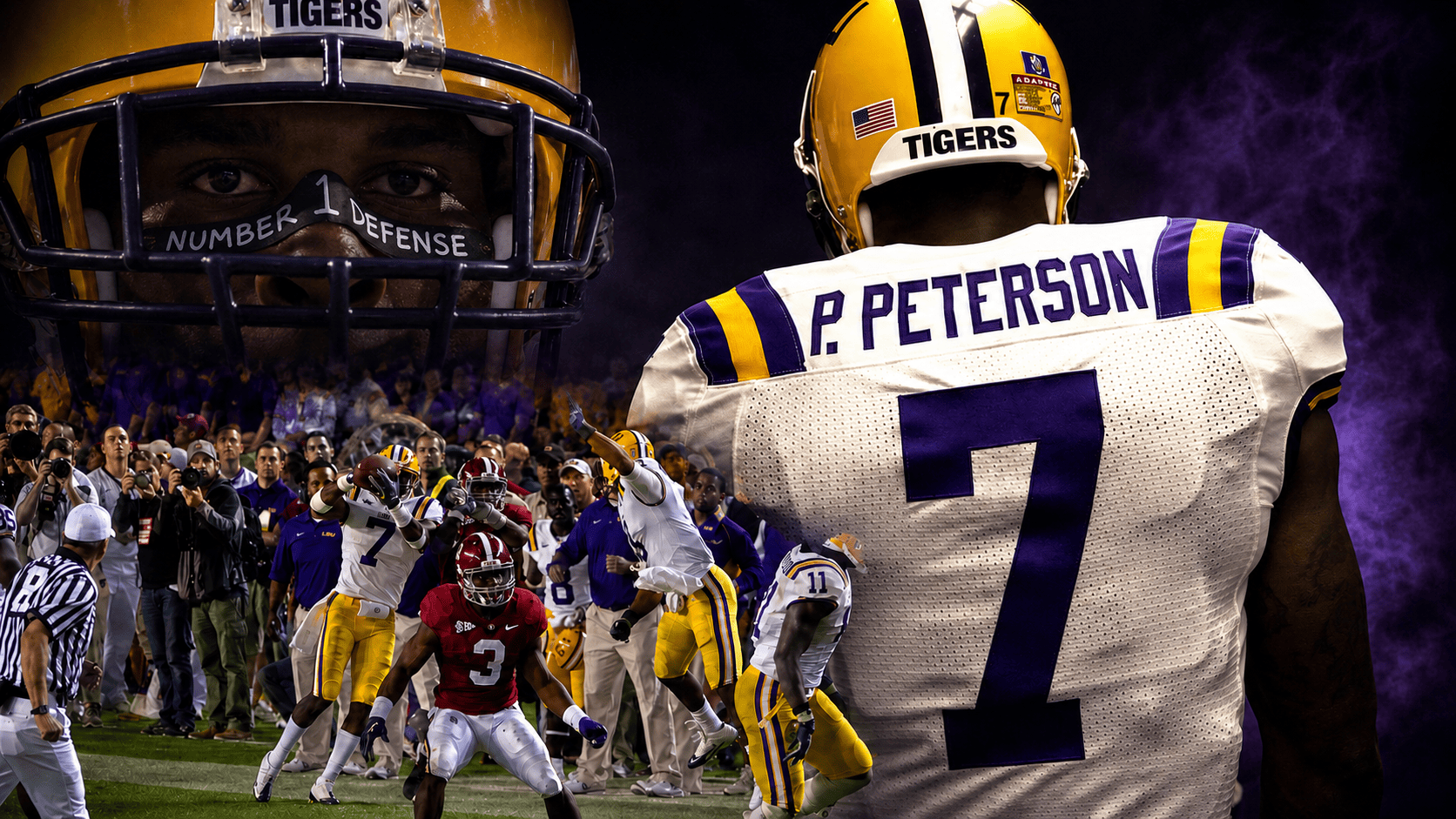
But before No. 7 became a modern branding tradition, it belonged to a quarterback who helped define LSU football in the early 1970s. Jones started from 1970-72, went 26-6-1, led LSU to three bowl games and the 1970 SEC championship, and left as the school’s career record holder at the time in passing yards, touchdown passes, attempts and completions. In 1972, he became LSU’s first quarterback to top 3,000 career passing yards, then became the first LSU quarterback to earn first-team All-American honors and finished fourth in the Heisman Trophy voting.
The Bert Jones story, though, casts the number back in time, into an older LSU story that somehow still points forward to 2026.
Indeed, LSU history always seems to hold ghosts, grudges, and old rivalry wounds that refuse to go away.
Perhaps Jones’ most famous LSU moment came on November 4, 1972, in Tiger Stadium, when No. 6 LSU trailed rival Ole Miss 16-10 in the final seconds. The game ended, or at least the Rebels thought it ended, before one more second appeared on the clock. Jones then found Brad Davis in the corner of the end zone for the touchdown, and Rusty Jackson’s extra point gave LSU a 17-16 win that still lives in Ole Miss lore more than half a century later—perhaps one of those ghosts that made LSU’s Kiffin hire even more egregious. Tiger Rag’s Glenn Guilbeau revisited the play last year, with Davis remembering that he lost the ball in the lights and Jones joking about the old clock controversy that has followed the game and history ever since.
“I lost it in the lights,” Davis told Tiger Rag for that story. “There was a lower row of lights in the stadium that I looked right into as the ball was coming.”
“I threw a terrible pass,” Jones told Tiger Rag. “I didn’t realize it until I saw a replay. And I have no idea why. But it gave Brad a great opportunity to catch it. All he had to do was grab one end, because it was an end-over-end pass. I was trying to make it easy for him.”
Advertisement
“It looked like Bert had kicked the ball to me instead of throwing it,” Davis said. “It looked like a wounded duck. Then I lost it in the lights for a second. But it hit me right in the right hand. I just felt it and grabbed it. I didn’t have much room. I had run right to the flag. I was trying to get across the line.”

Guilbeau continues the story, one we invite you to read in full, as it gives much more detail than we do here today:
The story of this game was not the game-winning touchdown. It was how LSU even got to that play. Before Davis was “Blinded by the Light,” a remake of the 1951 sci-fi thriller “The Day The Earth Stood Still” happened at Tiger Stadium with a new name, “The Day The Clock Stood Still.”
Two plays before the winning touchdown pass, LSU was on the Ole Miss 20-yard line when Jones threw over the middle for split end Gerald Keigley, but an Ole Miss defender knocked him down before the ball arrived. Interference was called, and LSU got a first down at the 10-yard line with just four seconds remaining.
Time enough for one more play, right? That’s what I was thinking listening to the game on the radio in Metairie with my dad as an 11-year-old.
“Time for one play in the game,” is exactly what the great John Ferguson, the Voice of LSU Football, said at the time. “Four seconds to go in the game. First down for LSU after the pass interference at the 10-yard line. But all that means nothing unless the Tigers can get the ball into the end zone on this play. And a big season rides on this play and the right arm of Bert Jones.”
Jones threw over the middle again and into the end zone for senior split end Jimmy LeDoux. But Mickey Fratesi broke up the pass cleanly, and Ole Miss fans went wild. Some even started for the field.
But a bright “00:1” flickered on the Tiger Stadium scoreboard.
“One second left to go,” Ferguson said almost in disbelief. “One second to go. The pass was broken up in the end zone. One second to play.”
If Ferguson was in disbelief, imagine the Ole Miss players and fans.
“There’s no way that next to last play could have taken only three seconds,” Ole Miss safety Harry Harrison said in 2022. “We were convinced we’d won the football game.”
“We thought the game was over,” Davis said. “I mean there was four seconds left before the last play. But when we looked up, there was one second left. Everybody thought it was over before that. We were all getting ready to walk off the field.”
The Ole Miss press guide the next year printed the score from the game, “Ole Miss 16, LSU 10 … + 7.”
The jersey retirement this coming fall won’t be just about an all-time LSU great. If you squint just enough, it may even be about No. 7 being lifted into Tiger Stadium with both halves of its LSU meaning intact.
The No. 7 of 2026 is supposed to mean speed, swagger, and playmaking ability. The No. 7 of old belongs to a different kind of player, one who could make a Tiger Stadium crowd of 70,502 rise to a deafening roar with a single moment that still echoes through LSU–Ole Miss history.
He was given an extra play, and he made it.
And now Lane Kiffin is the LSU coach living inside that history.
No wonder they hate him so much.
Something tells us a picture of Bert Jones may very well end up on his Twitter feed when he announces the 2026 version of No. 7.

Advertisement
Advertisement
