
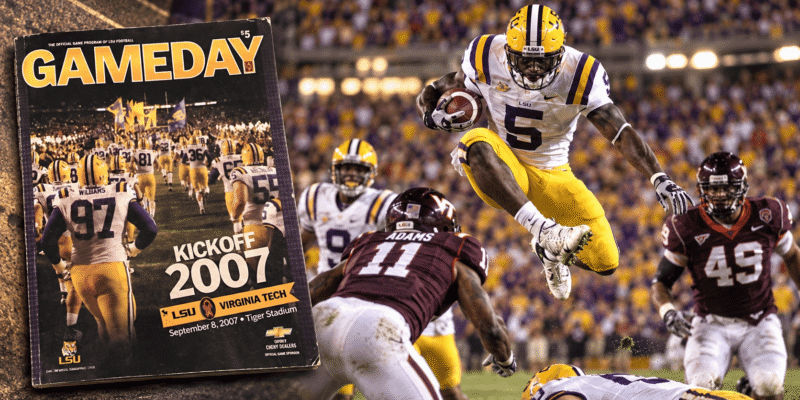
I was there in 2007, on a hot September night just over a week after No. 2 LSU opened the season with a 45-0 drubbing of Mississippi State on ESPN.
None of our group could have expected the total annihilation that was about to take place.
The game also came less than five months after the April 16 massacre at Virginia Tech, in which 32 students and faculty members were killed. Worth remembering if only out of respect.
When Les Miles and the Tigers hosted the No. 9 Hokies that night, and whenever I write about the full Tiger Stadium experience—the version everyone tries to describe through decibel readings and stories about the ground shaking—this remains one of the nights I remember.
ESPN’s College GameDay was on campus. Nearly 93,000 people packed what was then the largest crowd in Tiger Stadium history. This was supposed to provide the first legitimate measure of Les Miles’ third team, one that, led by quarterback Matt Flynn and a loaded roster that finished the 2006 campaign with a Sugar Bowl trouncing of Notre Dame and a No. 3 national ranking, was looking up only at vaunted USC in the polls.
And of course Lee Corso picked the Tigers on GameDay.
With 2003 still clear in the rearview, Tiger fans were salivating for another title—first and foremost because they knew it was actually possible now.
Virginia Tech had Frank Beamer, the country’s most feared special-teams operation, and a defense boasting its usual dogged reputation.
Lunch pail guys.
And that night LSU made the Hokies look like peasants.
The Tigers drove 87 yards for a touchdown on their first possession, then went 85 yards for another. Matt Flynn hit Brandon LaFell on a 56-yard slant, Jacob Hester kept bulldozing defenders, Craig Steltz intercepted a hapless Sean Glennon, and Keiland Williams turned an option pitch into a leap over a defender and a 67-yard touchdown that I still remember moving directly toward my pal and me as we jumped up and down with the crowd.
By halftime, it was 24–0, and the game was over.
Sort of like the other night, frankly.
From inside the stadium, the experience transcended the score. This was Tiger Stadium operating at full capacity—not merely full of screaming mouths but full of the growing realization that this whole Nick Saban to Les Miles run, even without departed JaMarcus Russell, was legitimate. The good times weren’t going anywhere as so many of us had learned to fear through the Arnsparger and DiNardo years. LSU was bigger, faster, and more physical than another top-ten team, one whose national profile still rivaled LSU’s. Only eight years earlier, quarterback Michael Vick had led Virginia Tech to the national championship game against Florida St, and although he turned pro after the 2000 season, his generational talent and popularity had helped elevate the entire program.
But not on this night. On this night, the Tigers indirectly punched their ticket to New Orleans in January. When perhaps the most topsy-turvy and unbelievable conclusion to a college-football season eventually played out, LSU rose from No. 7 to No. 2 in the final BCS standings, jumping a Virginia Tech team that had also won its conference championship and entered that final weekend ahead of the Tigers. Missouri and West Virginia had lost, LSU had beaten Tennessee for the SEC championship, and the voters were left to choose between two-loss LSU and two-loss Virginia Tech. The 48–7 result from September made that decision a cinch.
No one thought all those things that happened that final weekend would happen, which is why LSU had haphazardly fallen behind the Hokies in the first place. But they did.
And it would have been egg on voters’ faces had Virginia Tech been chosen to play Ohio St with 48-7 still very memorable in the college football world’s mind.
Even Coach Beamer couldn’t disagree with being leap-frogged by the Tigers. “We’re not the same team we were when LSU beat us,” he said. “But the fact is, they did beat us. So they deserved to be ahead of us.”
I respected him for that.
The final numbers of that September 8 night spelled a similar domination to what occurred in Death Valley this past Saturday. LSU outgained Virginia Tech 598–149, rushing for 297 yards and passing for 301. Williams gained 126 yards on only seven carries. LaFell caught seven passes for 125. Virginia Tech replaced Glennon with freshman Tyrod Taylor, but even a quarterback who would eventually spend more than a decade in the NFL couldn’t stop the storm.
Advertisement
People forget how nasty LSU’s defense was early that year, before the season’s general grind and injuries diminished some of its dominance. Starting defensive tackle Charles Alexander tore his ACL before the third game, while star Glenn Dorsey suffered the knee injury against Auburn that slowed him through the later stages of the season. Dorsey continued playing—often effectively—but he was no longer the demolition man who had helped LSU dismantle its first several opponents.
LSU won the game 48–7, establishing the largest margin of victory over a top-ten opponent in program history.
I also remember Lee Corso extending his shock beyond college football at halftime, saying—or joking to the effect—that LSU could finish second in the NFL’s AFC East. I received a text on it at some point, can’t quite remember, and I couldn’t find his exact words for this piece either, but the general point indeed parallels the national reaction back then. LSU had not simply defeated the ninth-ranked team in America. It had made it appear like two completely different levels of football.
Sort of like LSU-Clemson three days ago.
Virginia Tech would recover, winning the ACC and finishing No. 9 in the country. That made the September 8 thrashing look even more remarkable by season’s end. The Hokies were not frauds. They were in fact a fantastic football team led by a damn solid coach.
LSU was simply that spectacular that night.
The 2007 season would eventually become famous for its overtime losses, Les Miles’ questionable clock management, intrepid fourth-down conversions against Florida, and the wild season-ending sequence that returned LSU to the national-championship game.
And the Miles-to-Michigan thing that never happened.
And… the Ryan Perrilloux that could have been.
Before all of that, though, came the night when Tiger Stadium felt like every story told about it—like it had been in September 1995 when I was there for DiNardo’s “Bring Back the Magic” game against Auburn. It was a night when the entire country discovered that LSU had something special, and that a new collision course with the Trojans was entirely possible.
USC’s subpar season prevented that collision from ever happening, but that didn’t affect the joy that September 8 had revealed. I had been inside Tiger Stadium when the magic returned against Auburn in 1995. Twelve years later, I was there when LSU demonstrated that the magic was no longer something it needed to bring back.
Thank you for reading The Hayride!
—
For more nostalgia on that 2007 season, read our series from 2019! This link will bring you to the final post, which includes all the links to the rest at the bottom.
REMEMBERING 2007: Part IV, One Remarkable Ending
Advertisement
Advertisement
